Few questions in antiques have such a large financial gap between the two possible answers. Solid sterling is valuable as metal alone before anyone considers craftsmanship, while electroplated ware has almost no intrinsic value and sells on decorative appeal. The good news is that the law made this easy to check, and the answer is usually stamped on the object.
What proves a piece is sterling?
A genuine assay hallmark. In Britain that means a standard mark showing the purity, most commonly a walking lion for sterling, together with a town mark identifying the assay office, a date letter and a makers mark.
The lion and the town symbol are the crucial pair. Plated goods cannot legally carry these, because the piece was never assayed and is not silver throughout. If both are present and look consistent with each other, you are almost certainly holding solid silver.
What marks appear on plated items?
Plated wares carry marks that are designed to look reassuring without making a false claim. Letters indicating electroplated nickel silver are the most common, along with brand names, pattern numbers, and sequences of small symbols arranged in a row to resemble a hallmark at a glance.
Look closely at those symbols. A hallmark contains a specific set of meaningful punches; a plated mark contains shapes chosen because they look like one. Words describing the plating process or the base metal are a clear indication, since real silver has no need to describe itself.
Are there physical signs as well?
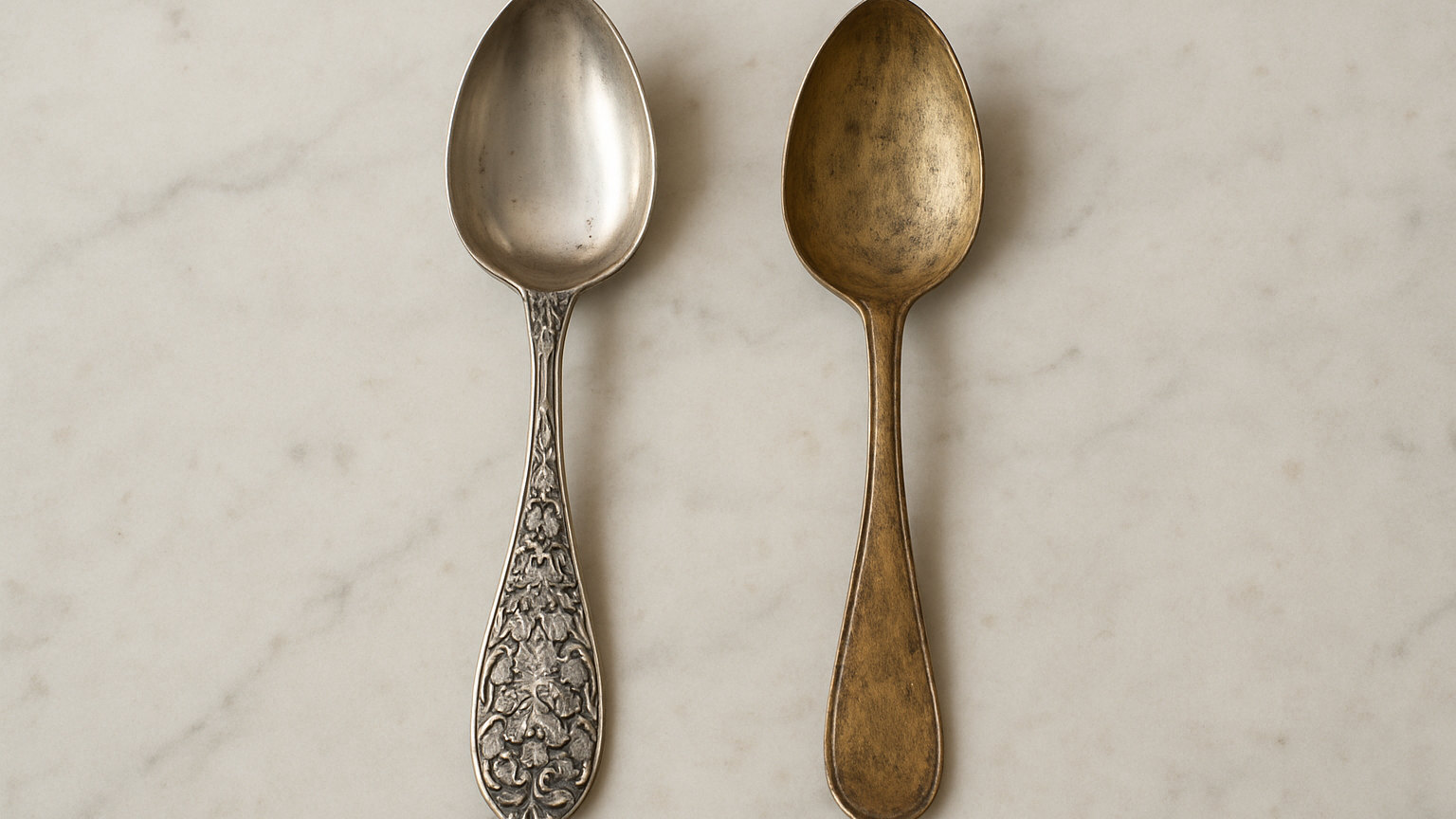
Yes, and they are useful when marks are worn away. Examine high points and edges, which wear first. On a plated piece the silver layer eventually rubs through to reveal warm pink copper or a yellowish base metal underneath, and once you have seen this you cannot miss it.
Weight and feel help too. Solid silver is dense and feels substantial, and it warms in the hand more readily than nickel alloys. Sterling tarnishes to a soft grey black; plated items over a nickel base can tarnish to a more yellowish tone. None of these is conclusive alone, but together they build a picture.
What is old Sheffield plate?
It is an earlier and quite different process, in which a sheet of silver was fused to copper and the combined sheet worked as one material. It predates electroplating and it is collectable in its own right, with values well above later electroplate although below solid silver.
The tell is the edge. Because the silver layer had to be turned over the copper, makers often applied a separate silver wire to the rim to conceal the copper core, and you can sometimes see a fine seam. Worn areas show copper bleeding through in a soft blush rather than the sharper break of electroplate.
Should you test with chemicals?
Generally not. Acid testing kits work by damaging a small area of the surface, and on an antique that damage is permanent and visible. On a hallmarked piece there is no need, because the mark already answers the question.
If a piece is unmarked and the answer matters, take it to a jeweller or an assay office, both of which can test non destructively using electronic equipment. Never file into a piece to reach the base metal, since that reduces the value of a genuine item to satisfy a curiosity a specialist could settle in a minute.
Does plated ware have any value?
It has decorative and practical value rather than metal value. Good quality plated tableware from established makers sells steadily, particularly complete canteens of cutlery, large serving pieces and anything with attractive design.
Replating is possible and not especially expensive for simple shapes, though it is worth remembering that replating removes some of the original detail on engraved or chased surfaces. On a piece with fine engraving, worn original plating is frequently preferable to a crisp new coat.
How should you look after either one?
Handle both gently and polish rarely. Every polish removes a microscopic layer of metal, which matters enormously on plate because the silver layer is finite, and matters on sterling because it softens hallmarks and wears away engraving.
Store items wrapped in acid free tissue or tarnish resistant cloth, keep them away from rubber bands and newspaper, and wash by hand rather than in a dishwasher. Tarnish is a surface reaction and does no harm; over polishing is permanent damage.