Silver tea services are among the most frequently inherited antiques and among the easiest to misjudge. Value depends far more on whether the pieces genuinely belong together than on the weight of metal, and assembled services made up from unrelated pieces are common enough that checking should be routine.
What does a complete service consist of?
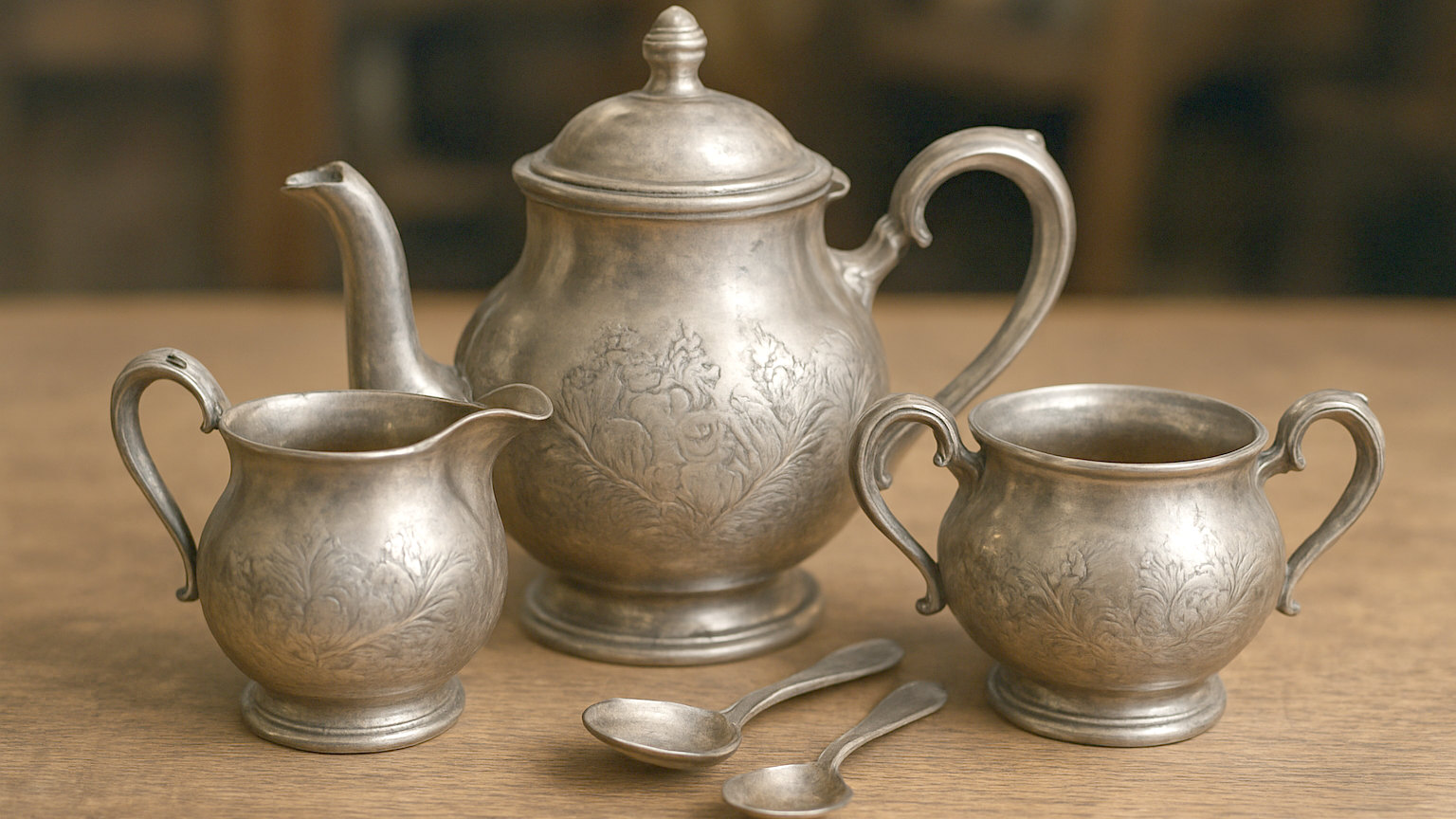
At minimum a teapot, a cream jug and a sugar bowl, which is the classic three piece service. A four piece adds a hot water jug or a coffee pot, and larger services add both along with a matching tray.
Some include a slop bowl for used leaves and a covered sugar box. When a service is described by a number, establish exactly which pieces are counted, since a four piece with a tray is quite different from a four piece without.
How do you check the pieces belong together?
Read the hallmarks on every piece, not just the teapot. An original service should share a maker mark and an assay office, and the date letters should be identical or within a very close run of years.
Different makers, different offices or dates separated by more than a few years indicate an assembled set. Some genuine services were added to over time, which is honest and should be disclosed, but it does reduce value compared with a service made as one commission.
What else should match?
Everything visible. Line the pieces up and compare the profile of the body, the shape and attachment of the handles, the form of the feet or foot rim, and the pattern of any engraving or applied decoration.
Check any engraved crest or monogram carefully. On an original service these were engraved at the same time by the same hand, so the style, depth and wear should correspond exactly. A crest that differs in size or execution on one piece is a strong indicator that piece came from elsewhere.
Where are the marks on each piece?
Usually on the base, and separately on any detachable part. Lids should carry their own marks, frequently a partial set, and those should agree with the body they sit on.
A lid with a different date or maker from its pot is a marriage. This is very common, since lids were dropped and lost, so check every one. On teapots also look at the finial and the hinge, which are frequently replaced and should show wear consistent with the rest.
What condition problems matter most?
Splits at handle joints and around the spout base, where stress concentrates, and repairs in soft solder which appear as dull grey deposits quite unlike silver.
Check the interior of the teapot for corrosion and pitting from tannin and water left standing. Look at the base for thinning, which shows as slight flexing under gentle pressure. Dents can be removed by a silversmith; splits and pitting are more serious and expensive.
What about handles and insulators?
Handles of wood, bone or ivory were fitted precisely because silver conducts heat. Where a silver handle is used, small insulating spacers were usually built into the join.
Check that handles are sound and firmly attached, since these are the parts most likely to have been replaced. A replacement handle is acceptable and should be disclosed, but a modern plastic substitute noticeably reduces value. Never immerse a piece with an organic handle in water.
Is a tea service worth using?
Yes, with care, and using one is far better than leaving it in a cupboard tarnishing. Wash by hand promptly after use, dry thoroughly, and never put any piece in a dishwasher.
Do not leave tea standing in a pot, since tannin stains and acidic residues corrode the interior. Store the pieces with their lids open rather than closed, so that moisture cannot be trapped inside, wrapped in tarnish resistant cloth and kept well away from rubber bands and newspaper, both of which contain sulphur and accelerate tarnishing badly.