Spoons are the ideal starting point for anyone learning silver. They survive in enormous numbers, they are cheap enough to buy and handle freely, they almost always carry a full hallmark, and their shape changed in a sequence clear enough to date them across a table. A tray of mixed spoons is the best teaching aid in the subject.
Why does the handle end matter most?
Because it carried the decoration and therefore followed fashion. The bowl changed too, but more slowly and less visibly, while the terminal at the end of the stem was redesigned repeatedly.
Look at the outline of that terminal first, and at whether the end turns up or down when the spoon is laid bowl downwards. That single observation narrows the period considerably before you examine anything else.
What are the main handle patterns?
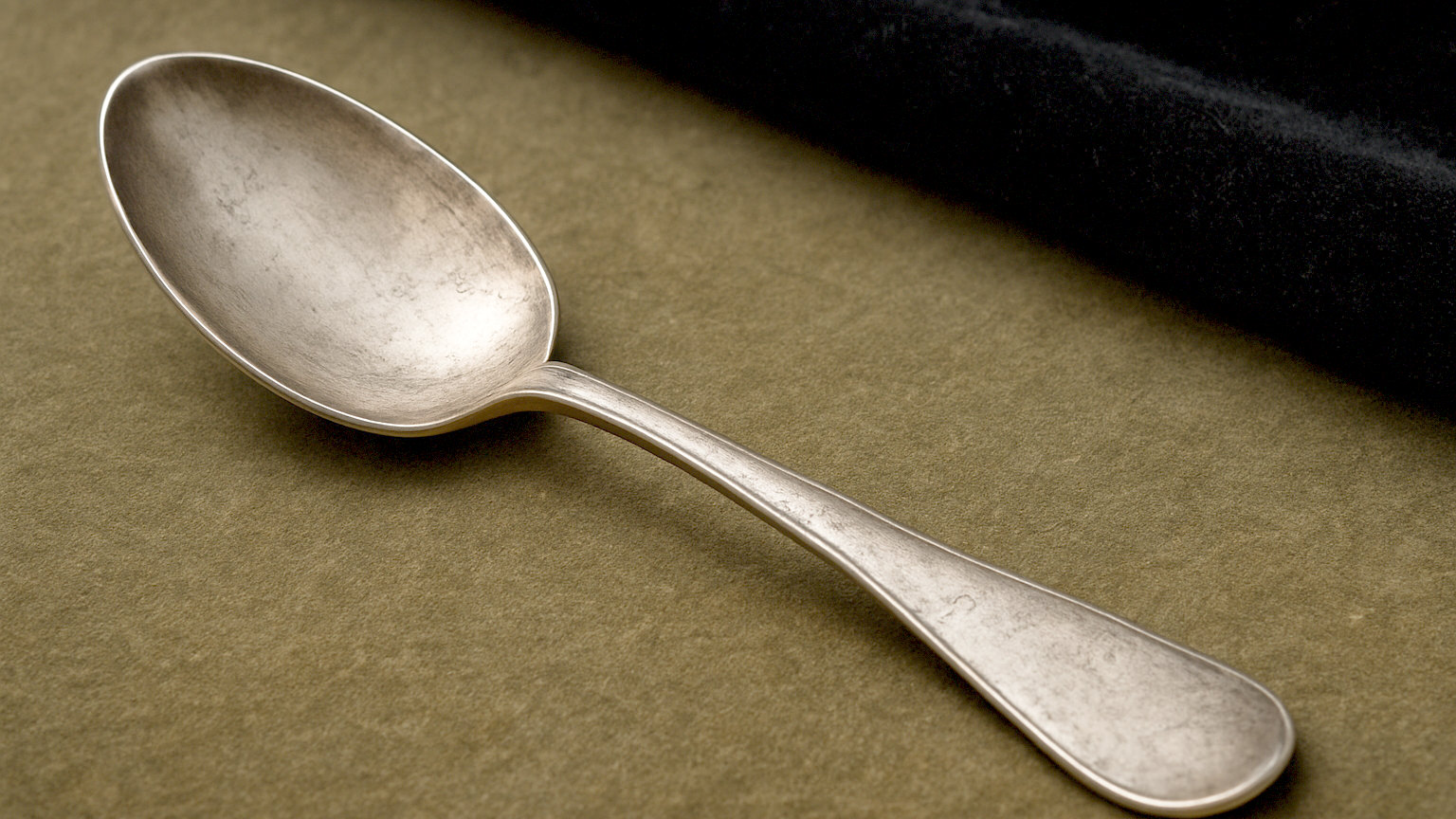
Old English is a plain stem widening to a rounded end that turns downward, and it is the pattern most people picture as a traditional spoon. Fiddle pattern has distinct shoulders where the stem meets the bowl and a broader waisted terminal resembling a fiddle outline.
Hanoverian, an earlier form, has a rounded end turning upward and a raised ridge running down the front of the stem. Later patterns add decoration to these basic outlines, with beaded, threaded and shell edges applied to the same underlying shapes. Recognising four or five basic outlines covers the large majority of what you will encounter.
Where is the hallmark on a spoon?
On the back of the stem, usually near the bowl on earlier examples and closer to the terminal on later ones, though position varies. Turn the spoon over and hold it under raking light, since marks on flatware wear heavily from decades of handling and stacking.
Marks may be struck in a line or grouped. Because the metal is thin and the surface curved, they are frequently partial. Read what survives rather than expecting a full set, and photograph the marks under angled light rather than trying to read them directly.
What is a bowl tip and why does it matter?
The pointed extension of the stem running down the back of the bowl, which strengthens the join where a spoon is most likely to break. Its shape changed over time, from long tapering forms to shorter drop shapes.
Look at whether the tip is a simple rounded drop, a double drop with a step, or a decorative shell or scroll. This detail is genuinely useful for dating and is frequently the feature that separates two spoons whose handles look almost identical.
How do you tell a genuine set from a made up one?
Check the marks on every piece rather than one. A genuine matched set will normally share a maker, an assay office and a date letter, or at least a very close run of years.
Compare weight, length and the exact profile of the terminal by laying them together and looking down the row. Small differences show clearly when pieces are aligned. Also check any engraved crest or initials, since a set assembled from different sources will often show engraving in more than one hand or with different wear.
What reduces the value of flatware?
Erased engraving is the most common problem. Where a crest or initials have been removed, the metal is thinner and often slightly dished, and holding the piece up to a light at a shallow angle will reveal a faint ghost of the original engraving.
Heavy wear to the bowl edge, bent or repaired stems, and split bowls all reduce value. So does over polishing, which softens hallmarks and rounds crisp pattern edges. A slightly tarnished spoon with sharp marks is worth more than a gleaming one with marks polished nearly flat.
Is silver flatware worth buying now?
It is one of the best value areas in antiques. Large quantities were made, households no longer use it daily, and prices for common patterns sit remarkably close to the value of the metal itself.
That means you can buy genuine period silver, hallmarked and datable to the exact year, for very modest sums. Buy single pieces to learn from, look for crisp marks and unerased surfaces, and build a matched set gradually if that appeals.