Formal dining once required a distinct implement for nearly every dish, and silversmiths obliged with an extraordinary range of specialised tools. Those objects survive in quantity and are frequently misidentified, sometimes innocently and sometimes because one name sells better than another. Knowing what a shape was actually for is worth real money.
Why were there so many?
Because dining became elaborate and because silversmiths had an obvious commercial interest in persuading households they needed more pieces. A canteen might contain a dozen different specialist implements.
Each was designed for a genuine practical purpose, however obscure it now seems. Understanding the purpose usually explains the shape, which is the quickest route to identifying an unfamiliar object rather than searching blindly.
What is a fish slice?
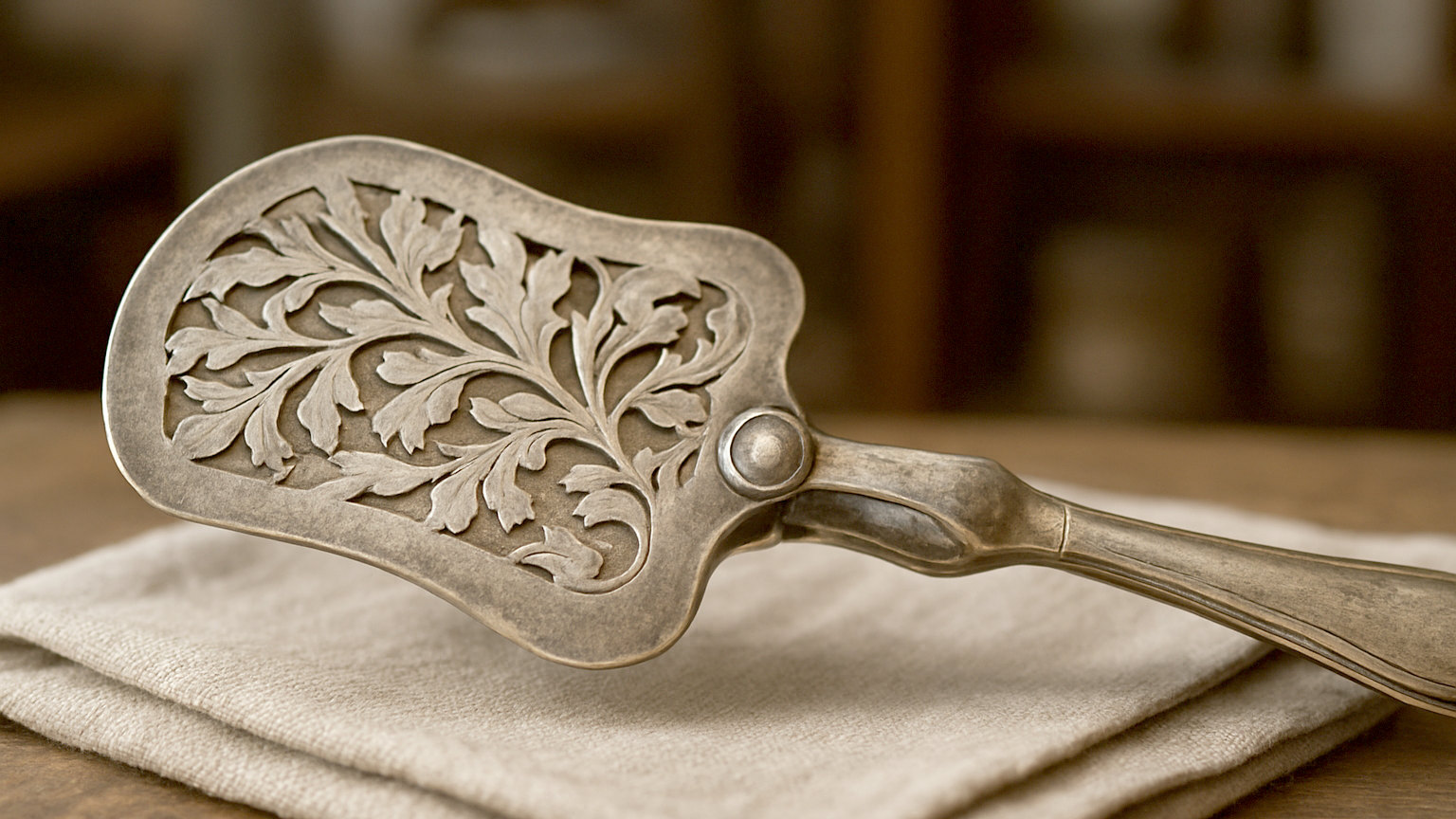
A broad flat blade, frequently pierced with a decorative pattern, used for serving fish. The piercing let liquid drain and gave the smith an opportunity to display skill.
Early examples have long slender handles and elegant blades, and the piercing on good ones is genuinely fine. They are frequently sold as cake slices or trowels, and the piercing is the giveaway, since a cake server has no need to drain anything. A matching fish fork doubles the value of a slice.
What is a marrow scoop?
A long slender implement with a narrow channel at each end, or a channel at one end and a spoon bowl at the other, used to extract marrow from bones. The two channels are different widths to suit different bones.
These are commonly mistaken for something else entirely because the purpose is unfamiliar now. They are collected in their own right and turn up regularly. Check both ends for damage, since the thin channels bend and split.
What is a caddy spoon?
A short handled spoon with a broad shallow bowl, used to measure tea from a caddy. Because tea was expensive and kept locked, the caddy spoon was a small showpiece and smiths produced them in imaginative shapes.
Shell forms, leaf forms, jockey caps and hands all appear. They are among the most collected small silver objects because they are inexpensive to start with, endlessly varied, and precisely datable from their hallmarks. Check the bowl for thinning and splits at the junction with the handle.
What are sugar tongs and nips?
Tongs lift lump sugar and come in two main forms: a sprung bow shape, and an earlier scissor form with a pivot and finger rings, usually called sugar nips.
Bow tongs should spring back cleanly when squeezed; a pair that has lost its spring has been overstretched and is worth less. Check the grips, which are frequently shell shaped and prone to damage. Marks on tongs are usually on the inside of one arm and are often partial.
Which other pieces turn up often?
Grape scissors with ornate handles, asparagus tongs, butter knives with distinctive curved blades, mustard and salt spoons with gilded bowls, apostle spoons, berry spoons, and sifter or straining spoons pierced through the bowl.
Berry spoons are worth particular caution, since a great many are plain earlier spoons decorated with embossed fruit much later to increase their appeal. That is a form of clobbering, and a spoon whose decoration cuts across worn hallmarks has clearly been worked on after leaving the assay office.
How does completeness affect value?
Considerably. Serving pieces in their original fitted case, or matching a known flatware pattern, are worth substantially more than the same implement loose.
Pairs matter too: a fish slice with its matching fork, or grape scissors with their case, outperform singles. Check that any case is original to the piece by looking at whether the fitted recess actually matches the object, since married cases are common.
How should specialist pieces be cleaned?
Very gently, and around any pierced decoration rather than across it. Piercing is thin and the fine bridges between holes bend or break under pressure from a polishing cloth.
Use a soft brush for decorated areas, wash in warm water with mild detergent, and dry thoroughly and immediately. Never put any of these in a dishwasher, and never leave salt, mustard or egg sitting on silver, since all three corrode the surface and pit it permanently within days.