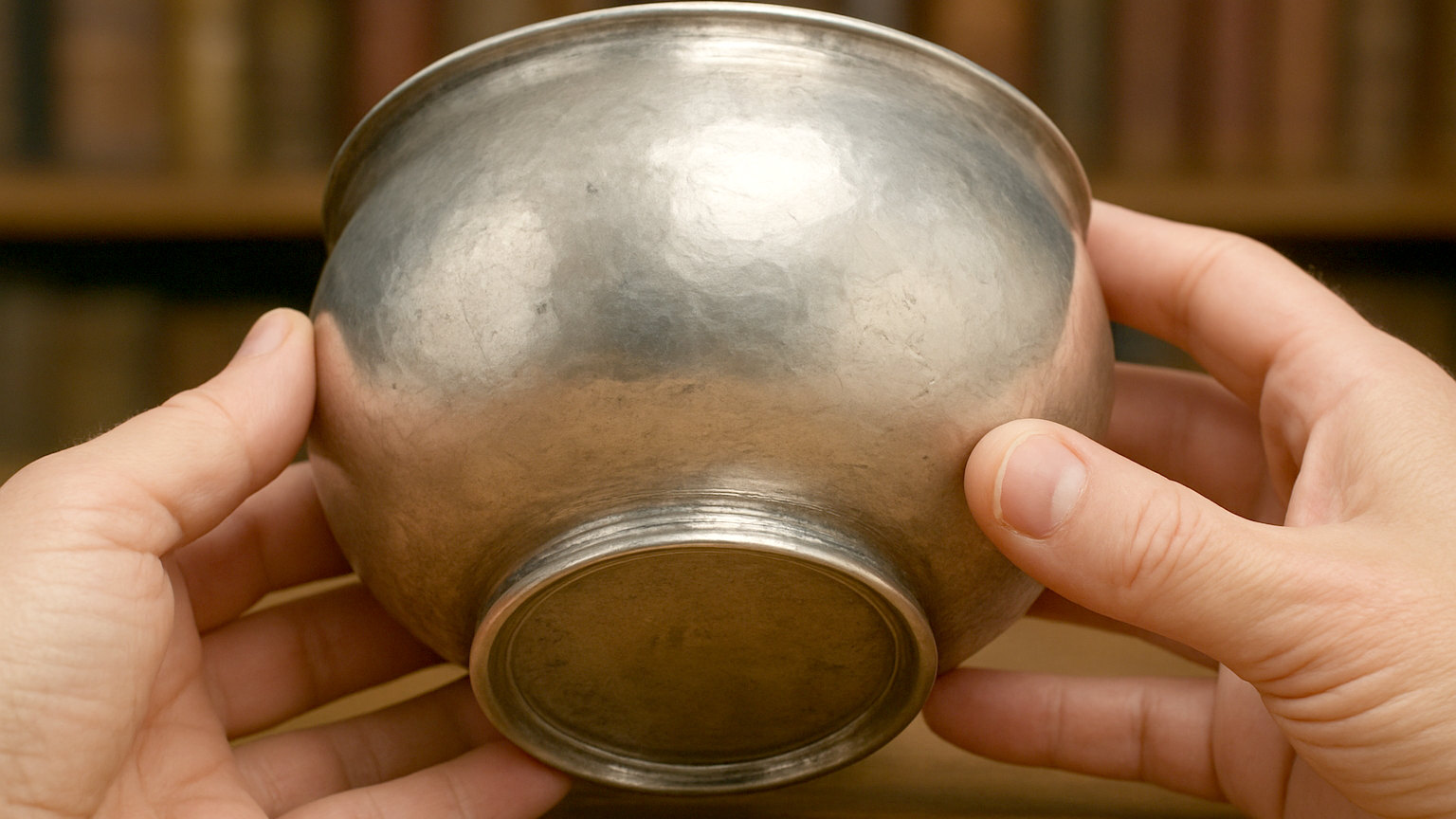
Bowls, dishes and salvers are the plainest silver forms and the easiest to assess honestly, because there are no hinges, spouts or handles to complicate matters. Most of what you need to know is on the base, and the two faults that matter most are thinning and erased engraving.
What forms will you encounter?
Sugar bowls, fruit bowls, rose bowls, and the small individual dishes made for sweets and nuts. Salvers, which are flat serving trays standing on small feet, and waiters, which are simply small salvers.
Also monteiths, which are large bowls with a notched rim from which wine glasses hung to cool in iced water, and bleeding bowls with a single flat handle. Identifying the form correctly matters, since a monteith is worth a great deal more than a plain bowl of similar size.
How do you check for thinning?
By feel and by light. Press very gently in the centre of the base with a thumb and feel whether the metal flexes, which indicates it has been worn thin by generations of polishing.
Hold the piece up to a strong light and look for any translucency or pinholes, particularly around the base and the foot rim. Thinning is progressive, irreversible and it substantially reduces value, since a thin bowl cannot be safely used or repaired.
What is erased engraving?
An engraved crest, coat of arms or set of initials that has been polished or scraped away, usually because a piece changed hands and the new owner did not want the old family displayed.
It is extremely common and it reduces value. Hold the piece at a shallow angle under a light and look across the surface: a faint ghost of the original engraving is frequently visible, and the metal in that area is thinner and slightly dished. Check the centre of any salver particularly.
Does an engraved crest add or subtract?
Generally it adds, provided it is original and identifiable. A crest that can be traced to a family gives the piece a documented history, and collectors of that family or that county will pay for it.
Later added engraving is a different matter and reduces value, since it is not part of the original object. Look at whether the engraving style suits the date of the piece and whether the wear on the engraved lines matches the surrounding surface.
What should you check on the feet?
That they are present, original and secure. Salvers stand on three or four small cast feet soldered to the underside, and these take knocks and pull away.
Look for splits in the metal around each foot, for repairs in soft solder showing as dull grey deposits, and for feet that do not match each other. A replaced foot is a common repair. Check the piece sits flat without rocking, which reveals both distortion and foot problems.
Where are the marks?
Usually on the underside, either near the rim or grouped in the centre. On salvers they are frequently arranged in a line on the reverse.
Read all four punches and check they are consistent. Because these are large flat surfaces, they are among the pieces most susceptible to transposed marks, so breathe on the area around the punches and watch for a fine rectangular outline appearing as the condensation clears.
How do you assess decoration?
By crispness. Chased and engraved decoration wears with polishing, so a piece with sharp defined ornament has been cared for while one with soft blurred decoration has been over polished.
Piercing on baskets and dishes should be clean with no broken bridges between the holes. Applied borders should be securely attached with no gaps. Compare the sharpness of the decoration against the sharpness of the hallmarks, since both wear at similar rates.
How should they be used and stored?
Washed by hand promptly, dried thoroughly and polished rarely. Every polish removes metal, and on a piece already thinning that matters a great deal.
Never leave salt, egg or acidic food standing on silver, since all three pit the surface permanently. Store wrapped in tarnish resistant cloth, away from rubber bands and newspaper. Do not stack dishes bare, since they scratch each other.