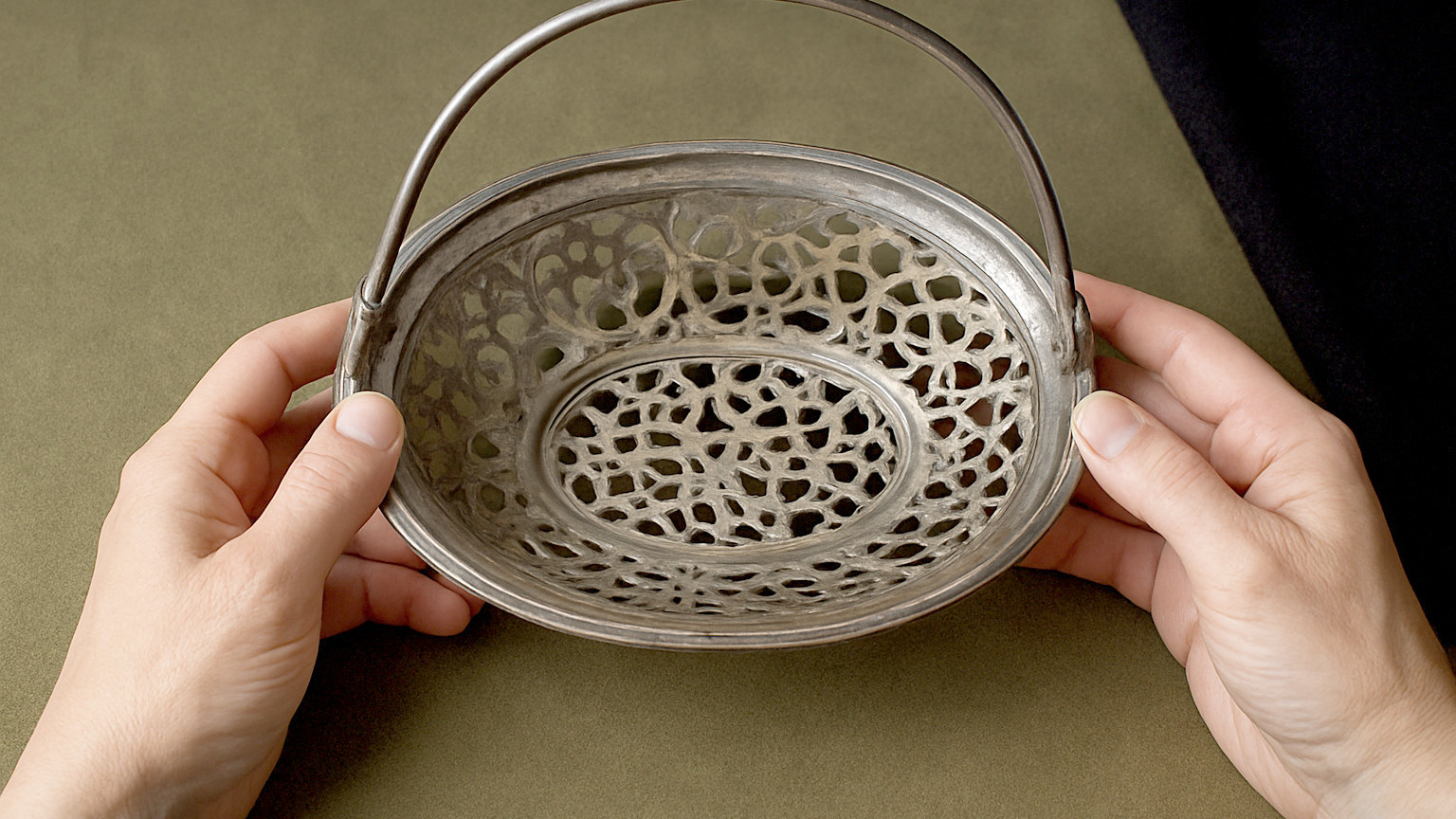
Baskets and trays are among the most decorative silver forms and among the most vulnerable, because piercing removes metal from exactly the places that need strength and a swing handle concentrates the whole weight of a loaded basket into two small pivots. Assessment concentrates on both.
What forms will you encounter?
Cake baskets with a swing handle, bread baskets, sweetmeat and bonbon dishes, and trays and salvers of various sizes. Also wirework baskets built from soldered wire rather than pierced sheet.
Trays are distinguished from salvers largely by size and by having handles, while a salver stands on small feet and has none. The distinction matters commercially, since a large tray is a substantial weight of silver and priced accordingly.
Why is piercing so vulnerable?
Because the bridges of metal between the holes are thin, and every one of them is a potential break point. On finely pierced work those bridges may be less than a millimetre across.
Hold the piece up to a strong light and look through the piercing systematically, checking for breaks, splits and previous repairs. Run a fingertip lightly over the surface feeling for anything that catches. Broken bridges are difficult to repair invisibly and reduce value considerably.
How do you check a swing handle?
At the pivots, which are two small pins passing through lugs on the body. Every lift of a loaded basket stresses those points, and they wear oval and eventually fail.
Swing the handle through its full travel and feel for excessive play. Look at the lugs for splits radiating from the pin holes and for repairs. A handle that flops loosely rather than staying where placed has worn pivots, which is repairable but should be reflected in the price.
What is the difference between piercing and cutting?
Hand piercing was done with a saw, producing slightly irregular edges and occasional overruns where the blade went marginally too far. Machine punched work is perfectly regular.
Look at the inside edges of the holes under magnification. Hand sawn piercing shows fine tool marks and tiny variations between repeated shapes; punched work is identical throughout. Hand piercing indicates earlier and better work and commands a premium.
How do you check a tray?
For thinning and for distortion. Trays are large flat surfaces that were polished constantly, and generations of cleaning wear the metal thin, particularly in the centre.
Press very gently in the middle and feel for flex. Hold the tray up to a strong light and look for translucency. Check it lies flat on a level surface without rocking, since distortion indicates it has been dropped or the feet have been disturbed.
What about the feet and mounts?
They take knocks and pull away. Trays and salvers stand on small cast feet soldered to the underside, and baskets frequently have an applied foot rim.
Look for splits in the metal around each foot, for repairs in soft solder showing as dull grey deposits, and for feet that do not match one another. Check applied borders are securely attached along their whole length with no gaps.
Where are the marks?
Usually on the underside, and separately on a swing handle where one is fitted. Check both, since a handle with different marks from the body is a marriage.
On pierced baskets look carefully, since the marks are frequently struck on a small solid area amongst the piercing. Because these are large flat pieces, they are among those most susceptible to transposed mark panels, so check for a seam around the punches.
How should they be cleaned?
Around the piercing rather than across it, and with a soft brush rather than a cloth for decorated areas. Pressure from a polishing cloth bends and breaks the thin bridges.
Wash in warm water with mild detergent, dry thoroughly and immediately, and polish rarely. Never let a cloth snag in piercing and pull, which is how bridges break during cleaning. Lift a basket by the body rather than the handle if the pivots are at all worn.