Slipware is among the oldest and most immediately appealing forms of decorated pottery, and it is also one of the easiest to recognise once you know what you are looking at. The decoration is made from clay rather than paint, which means you can usually feel it as well as see it.
What is slip?
Clay mixed with water to the consistency of thick cream, coloured by the natural minerals in the clay or by added oxides. It is applied to a pot before firing, then glazed over.
Because it is clay applied on top of clay, the decoration has physical thickness. Run a fingertip across a trailed line and you should feel it standing slightly proud of the surrounding surface. That single test distinguishes slipware from painted or printed decoration immediately.
How was it applied?
Several ways, each producing a recognisable effect. Trailing squeezes slip through a nozzle to draw lines and dots, rather like piping icing, giving raised outlines and blobs.
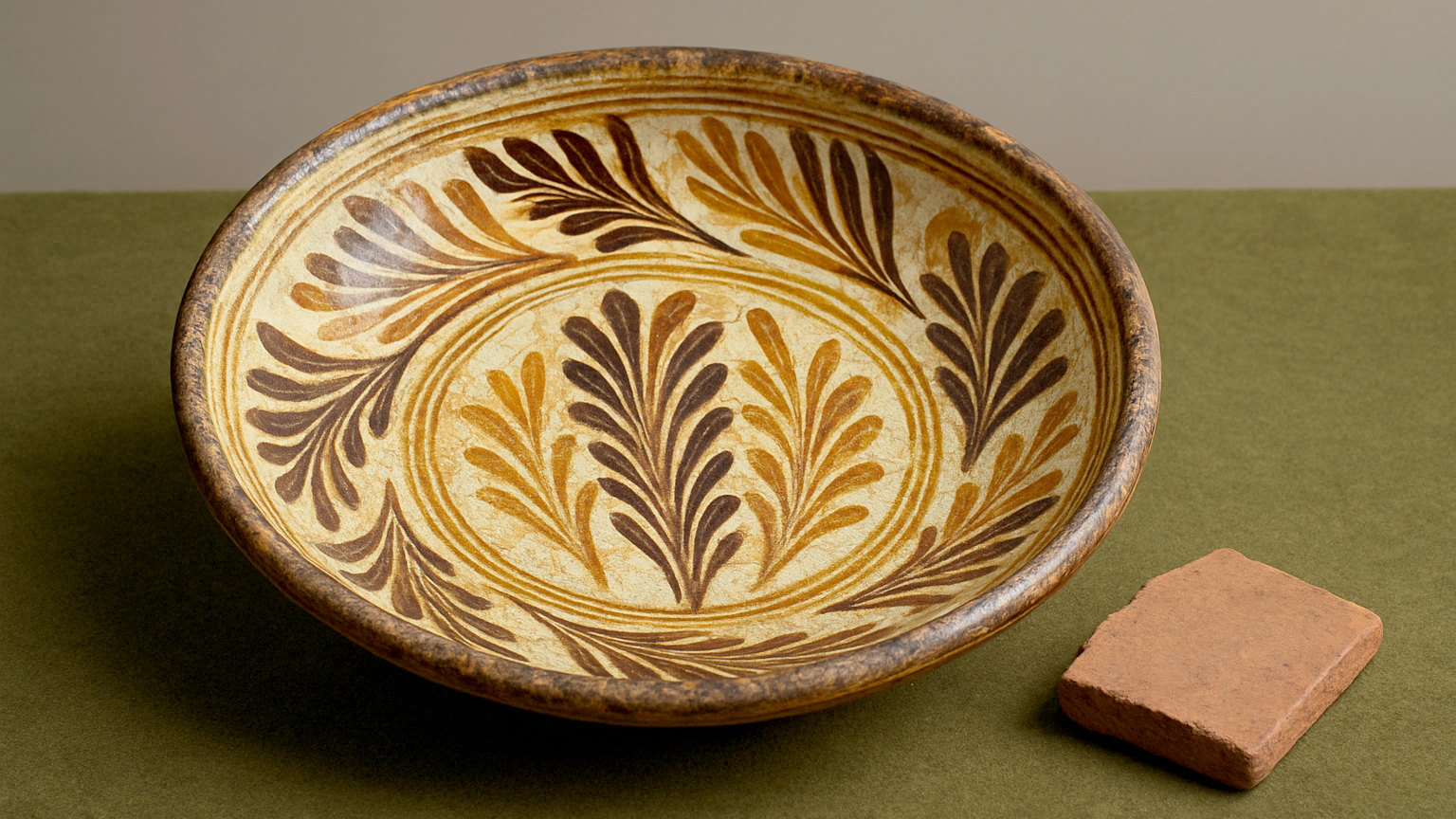
Combing drags a tool through wet slip of contrasting colour to produce feathered or wavy patterns. Marbling swirls two slips together. Sgraffito coats a pot in slip and then scratches through it to reveal the body beneath, producing a drawn line in the contrasting colour underneath.
What colours are typical?
Earth colours, because they come from the clay itself. Creams, buffs, warm oranges and rich browns predominate, with darker brown or near black from iron rich slips.
The glaze over the top is usually a clear lead glaze, which was often slightly yellow, so a white slip beneath it reads as warm cream rather than pure white. That yellowish cast over earth tones gives slipware its characteristic warm appearance.
What forms turn up?
Utilitarian shapes above all, since this was working pottery rather than display ware. Large chargers and dishes, jugs, bowls, cradles, money boxes, puzzle jugs and baking dishes.
Commemorative and presentation pieces are the exception and the most collectable, particularly chargers and dishes bearing a name, initials or a date trailed into the decoration. A dated piece is worth a substantial premium because it documents itself, and dated slipware attracts serious competition.
How do you tell old from later?
By the body, the wear and the irregularity. Genuine early slipware is earthenware, so a chip reveals a coarse buff, cream or reddish body quite unlike a modern refined clay.
Look for firing faults, slight warping, glaze crawling and uneven thickness, all of which are normal in country production and difficult to fake convincingly. Check the base for genuine wear: irregular scratches concentrated where the piece actually rested, rather than uniform scuffing across the whole underside.
Is studio slipware collectable?
Very much so. The technique was revived by studio potters in the twentieth century, and the best of that work is strongly collected in its own right at prices that can exceed ordinary country wares.
Studio pieces are usually marked with a potter seal or an impressed monogram, so check the base and the side near the foot. Do not assume an unmarked piece is early or a marked one is modern. Judge the body and the glaze first, and use any mark as confirmation.
How should slipware be handled?
Carefully, because the body is soft and the glaze is frequently crazed. Support large chargers from underneath with both hands rather than lifting by the rim, which is where they crack.
Do not use antique slipware for food, since lead glazes were common and crazing lets liquid into the porous body. Wash gently by hand if necessary, never soak, and avoid dishwashers entirely. Display on a stand that supports the base rather than gripping the edge, since a wire hanger concentrates load on two points of a brittle rim. Where a charger is hung on a wall, use a plate hanger sized correctly for the piece and check it periodically, because the tension in a spring hanger relaxes over time and the weight of a large slipware dish is considerable.