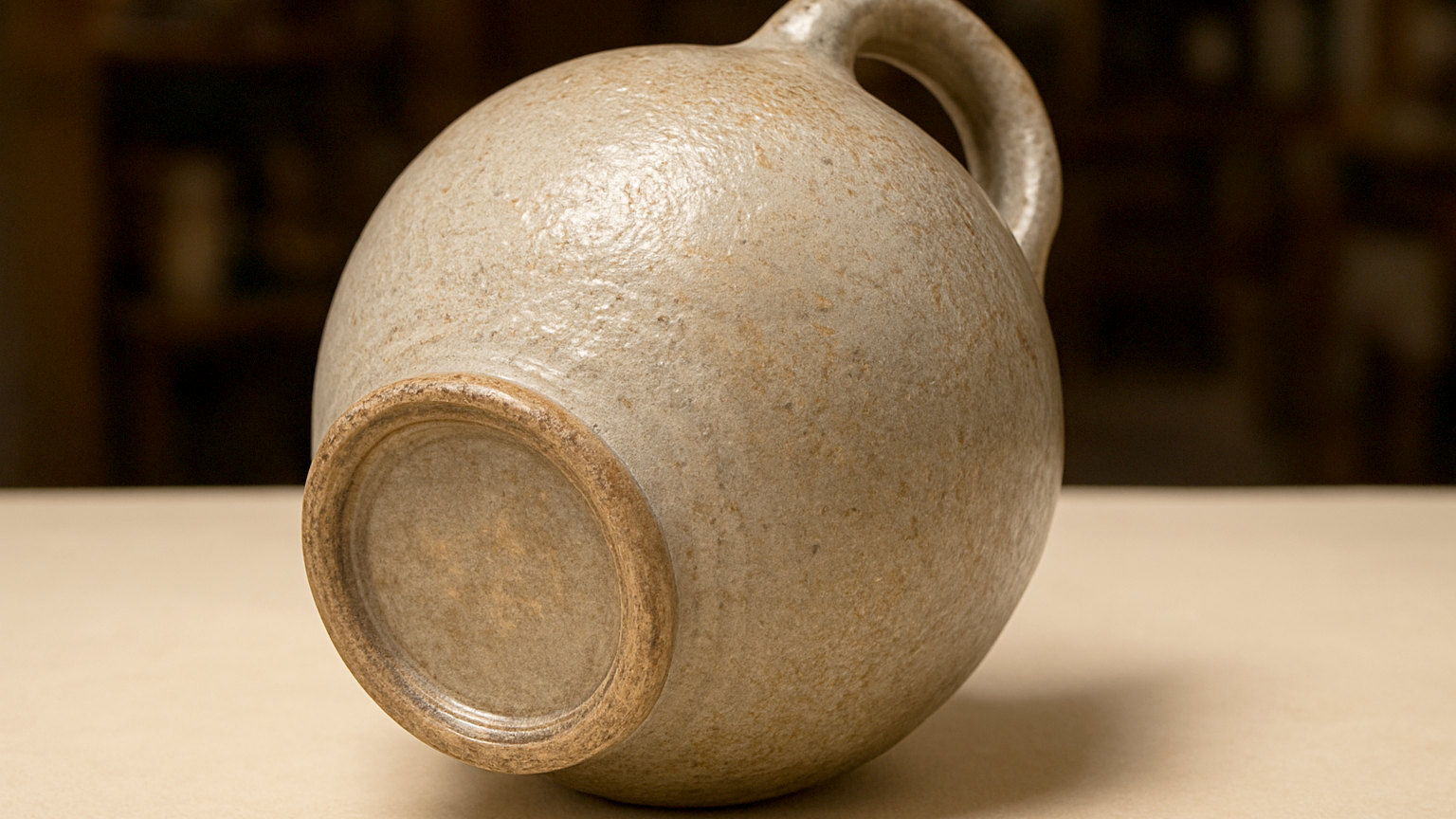
Salt glazed stoneware is among the easiest antique ceramics to identify, because the glaze has a texture no other process produces. Run a finger over a genuine piece and you feel a fine dimpled surface, frequently described as resembling orange peel. Once you have felt it you will never mistake it again.
How was it made?
By throwing common salt into the kiln at the peak of firing, at a very high temperature. The salt vaporises, reacts with the silica in the clay body, and forms a thin glassy glaze directly on the surface of the pot.
Because the glaze forms in the kiln atmosphere rather than being applied as a liquid coating, it covers every exposed surface including the inside of open forms. The reaction is not perfectly even, which is exactly what produces the characteristic dimpled texture.
What does the surface look like?
Finely pitted, with a slight sheen rather than a high gloss. Under raking light the pitting is visible as a network of tiny depressions across the whole surface.
The glaze is very thin, so it follows every detail of the form beneath rather than pooling in recesses the way a dipped glaze does. Applied decoration stays sharp under salt glaze, which is one reason it was used for pieces with moulded ornament.
What is the body underneath?
Stoneware, fired hot enough to vitrify, meaning the body itself becomes non porous. That is the crucial difference from earthenware, which stays porous and needs glaze to hold liquid.
Look at a chip: the body is dense, hard and usually grey, buff or brown throughout, with a slightly glassy fracture. A stoneware jug will hold water even where the interior is unglazed, which no earthenware can do. Tap the rim and you get a sharper note than earthenware gives.
What forms turn up?
Utilitarian shapes above all, since the process suited hard wearing wares. Bottles, jars, jugs, tankards, storage vessels, drainpipes and chimney pots were all made in salt glazed stoneware.
Decorative pieces exist too, including moulded jugs with relief decoration and figures. Reverse moulded jugs with hunting scenes and similar subjects turn up frequently. Ink bottles, ginger beer bottles and stoneware flagons carrying impressed retailer names are widely collected for the names alone.
What colours are typical?
Greys, buffs and browns, since the colour comes largely from the clay and the kiln atmosphere rather than from applied pigment. Many pieces have a two tone appearance, with a darker brown upper section over a paler body.
That contrast was usually produced by dipping the top in a slip before firing. Cobalt blue decoration appears on some traditions, painted directly onto the raw body since cobalt survives the very high firing temperature. Few other colours do, which is why the palette is so limited.
How do you spot later reproduction?
By the texture and the weight. Reproductions frequently imitate the colour without achieving the true salt glaze surface, so they feel smoother than they should under a fingertip.
Check for genuine wear on the base, irregular and concentrated where the piece actually rested. Look at the potting for slight asymmetry and throwing rings inside, which indicate hand work. Machine perfect uniformity and a smooth glossy glaze suggest later industrial production or an outright copy.
What should you check on condition?
Chips to rims and handles, which are the vulnerable points, and cracks running from the rim downwards. Because the body is dense and hard, damage tends to be sharp rather than crumbling.
Staining inside bottles and jars is common and largely harmless. Look for old repairs, which show under ultraviolet light as patches fluorescing differently from the surrounding glaze. Impressed names and dates add value substantially, so check the body, the shoulder and the base carefully for them under raking light, turning the piece slowly. Retailer names on bottles and flagons are collected by people researching that particular business, who will frequently pay well above the general market for a piece naming a firm they follow.