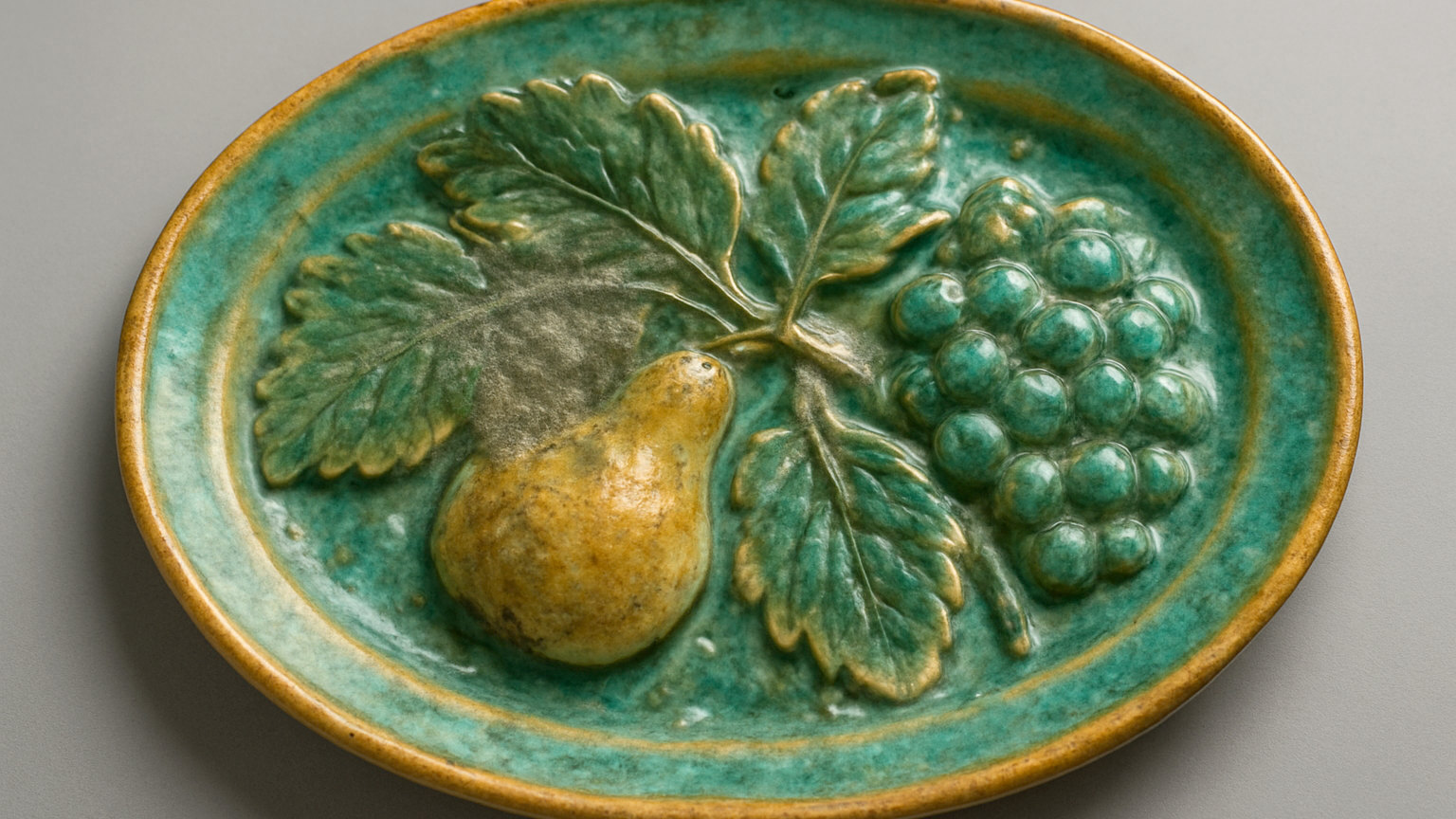
Majolica is instantly recognisable once you have handled a piece: heavily moulded earthenware under thick, glossy, brilliantly coloured glazes that pool in the recesses and run slightly into one another. It was made in enormous quantities, it fell completely out of fashion, and it has since recovered strongly.
How was it made?
An earthenware body was press moulded into shapes with pronounced relief decoration, then painted with coloured lead glazes and fired. The glazes are thick and fluid, so they flow during firing.
That flow is the defining characteristic. Colours pool deeply in the hollows of the moulding, thin on the raised areas, and blur slightly where two meet. No other ceramic technique produces quite the same effect, and it is visible from across a room.
What subjects turn up?
Nature, exuberantly. Leaves, ferns, flowers, fruit, fish, birds, reptiles and shells appear constantly, modelled in high relief and coloured naturalistically.
Common forms include jugs, plates and dishes shaped as leaves, cheese domes, jardinieres, umbrella stands, teapots modelled as animals and large garden seats. The design philosophy was to make an object look like the thing that inspired it, which is why so much majolica is a plate pretending to be a leaf.
What colours are characteristic?
Strong greens, ochres, browns, pinks, turquoise and cobalt blue, applied boldly rather than subtly. The palette is deliberately vivid and the glazes are glossy rather than matt.
Interiors of hollow wares and the reverse of plates frequently carry a mottled glaze in browns and greens, applied quickly, which is a useful identifying feature. That mottled reverse is characteristic and is worth checking on any piece.
What is the body underneath?
Earthenware, so a chip reveals a coarse buff, cream or pinkish body quite unlike porcelain. It is opaque, comparatively soft and porous, and it chips readily.
Feel the weight: majolica is heavy for its size because the moulded relief requires thickness. Tap the rim gently and you get a dull note rather than a ring. That combination of weight, softness and thick glossy glaze is diagnostic.
Why does condition matter so much?
Because the thick glaze chips and flakes readily, and because the soft body beneath shows through immediately as a pale scar. Damage is highly visible on a brightly coloured surface.
Check rims, the tips of any modelled relief, handles and feet, which are the vulnerable points. Crazing is extremely common and generally accepted as normal ageing, though heavy staining that has soaked through crazing into the body does reduce value.
How do you spot restoration?
With ultraviolet light, which reveals repairs as patches fluorescing differently from the surrounding glaze. This is worth doing on any majolica of value, since restoration on a coloured surface can be genuinely invisible in daylight.
Also run a fingernail over the surface: restoration feels warmer and softer than fired glaze, and the transition can often be felt as a faint step. Check the tips of relief decoration particularly, since these break first and are restored most often.
Is it safe to use?
Not for food. The glazes contain lead, the body is porous, and crazing lets liquid reach the body. Majolica should be treated as decorative regardless of what form a piece takes.
Wash gently by hand in warm water if necessary, never soak, and never use a dishwasher, which will destroy the glaze surface. Handle by the body rather than by projecting relief or handles, which snap. Display out of direct sunlight, since some glazes fade.
Who made it and are pieces marked?
Several major factories produced it alongside a great many smaller ones, and marking is inconsistent. Look on the base for an impressed or printed factory mark, a shape number and sometimes a registration mark or diamond device.
Shape numbers are useful because factory pattern books record them, so a number plus a maker frequently identifies a piece precisely. Unmarked majolica is extremely common and should be judged on the quality of the moulding and the glazes instead.
Is it worth collecting now?
It has recovered strongly after falling out of favour for most of the twentieth century, and good pieces by identified factories attract serious competition.
Condition drives the price more than almost anything else, so an undamaged piece is worth a substantial multiple of a chipped one. Large decorative forms and anything modelled with real invention do best, while small plates in common patterns remain affordable and are a sensible way to start.