Cut glass and pressed glass can look almost identical across a room and differ several fold in price. Pressed patterns were designed specifically to imitate cut ones cheaply, and they succeeded well enough that the distinction confuses people constantly. Fortunately your fingertips will find the answer faster than your eyes will.
What is the difference in how they are made?
Cut glass starts as a plain blank which is then ground against rotating wheels to grind facets, grooves and stars into the surface, and each cut is polished afterwards. It is slow skilled work carried out one piece at a time.
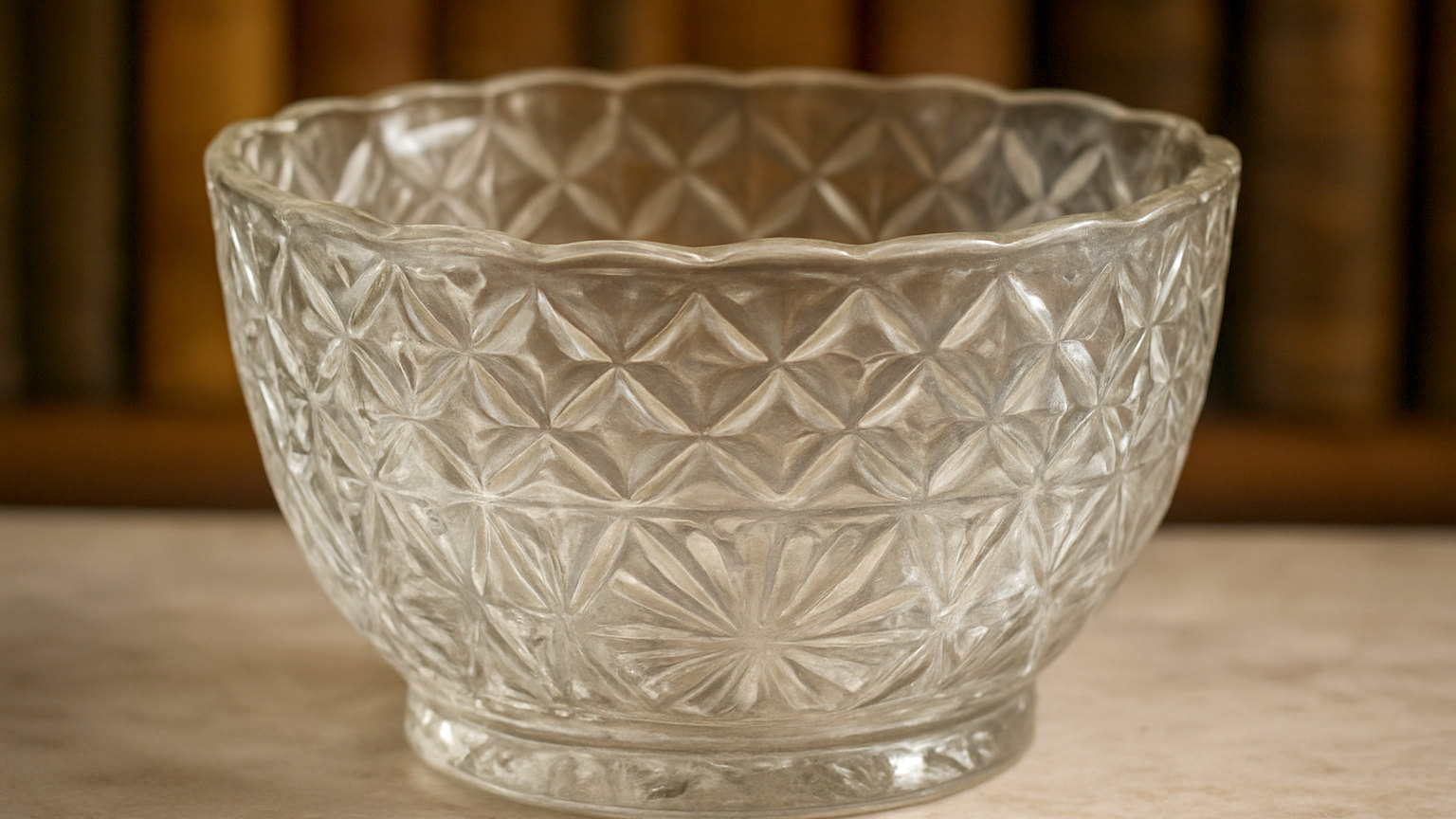
Pressed glass is made by forcing molten glass into a patterned mould under pressure, so the decoration forms as the object takes shape. One mould produces thousands of identical pieces with no hand finishing, which is why it cost so much less.
What is the quickest test?
Run a fingertip across the pattern. Cut decoration has crisp edges that you can feel distinctly, and on a sharply cut piece the ridges between facets can feel almost sharp enough to catch a nail.
Pressed patterns have softly rounded edges, because molten glass cannot fill a mould with a perfectly sharp corner and the surface flows slightly as it cools. Once you have felt both, the difference is obvious in a second and you will never need any other test.
Where should you look for mould seams?
On the outside, running vertically from base to rim, usually in two or more places depending on how many parts the mould had. They are frequently easier to feel than to see, so run a finger down the side of the piece.
Seams may pass through the pattern itself, interrupting the design slightly, which is a certain indicator. Cut glass has no seams anywhere, because it began as a blown or moulded blank whose surface was then entirely ground away where the pattern is.
What do the base and the points reveal?
Turn the piece over. A cut star or pattern on the base of a cut glass item is ground in and polished, with facets meeting at precise points. On pressed glass the base pattern is moulded and the points are rounded.
Look at where lines of the pattern intersect. Cut lines cross at a clean junction because the wheel travelled through in a straight path. Pressed lines meet with a slightly rounded or filled junction. Under a light, cut surfaces show a bright polish where pressed surfaces have a softer sheen.
Does weight and sound help?
Yes, though as supporting evidence rather than proof. Lead crystal, which most good cut glass is made from, is noticeably heavier than ordinary glass of the same size and gives a sustained ringing note when tapped gently on the rim.
Pressed glass is usually made from a cheaper metal without lead, so it feels lighter and gives a shorter duller note. Be aware that a cracked piece will thud regardless, so never rely on sound alone, and never tap hard.
Is pressed glass worth anything?
Certainly, and it is collected seriously in its own right rather than treated as a poor imitation. Early pressed glass, unusual colours, registered patterns and pieces from identifiable makers all attract collectors.
What matters is buying it as what it is. The problem only arises when pressed glass is sold at cut glass prices, which happens regularly because the pattern looks convincing in a photograph. Handle before buying wherever possible.
What condition issues should you check?
Chips on rims and feet, which are the most exposed edges, and internal cracks which show as bright lines when the piece is turned under a light. Run a finger carefully around every rim.
On decanters, check the interior for cloudiness, sometimes called sickness, caused by liquid left standing for long periods. It is etching of the inner surface, it cannot be washed out, and professional treatment is expensive and not always successful. Always hold a decanter up to the light and look through it before buying.