Paperweights are among the most collected glass objects and among the hardest to assess casually, because the value sits in the detail of the work suspended inside a lens of clear glass. That lens both magnifies the interior and is itself the most vulnerable part of the object.
What is millefiori?
Decoration made from bundles of coloured glass rods fused together, drawn out to reduce the pattern in scale, then sliced across so each slice shows the design in miniature. Those slices are called canes.
Arranged in patterns and encased in clear glass, they produce the flower like effects that characterise the best paperweights. Look at the canes under magnification: fine, complex, well formed canes indicate skilled work, while coarse or distorted ones indicate the opposite.
What other types are there?
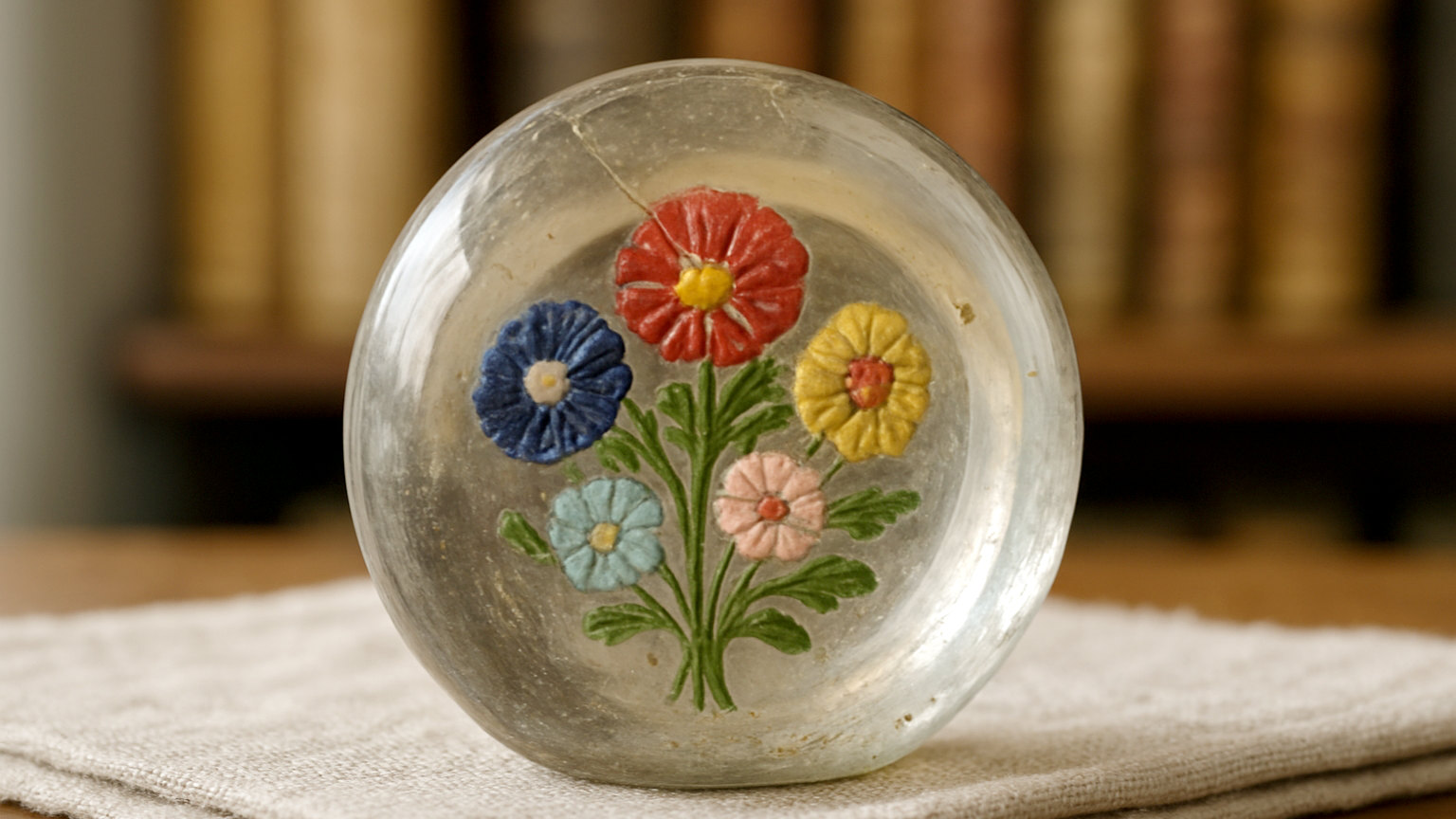
Lampwork weights, where flowers, fruit, insects or reptiles are modelled in glass at a flame and encased. Sulphides, containing a white ceramic portrait medallion. Overlay weights, cased in coloured glass and cut with windows to view the interior.
Each is judged differently. Lampwork is assessed on the realism and delicacy of the modelling; sulphides on the crispness of the portrait; overlays on the evenness of the casing and the precision of the cutting.
How do you assess the dome?
By clarity and by shape. The clear glass over the design is a lens, and its quality determines how well you can see what is inside.
Look for bubbles, striations and any cloudiness in the metal, though small imperfections are normal in older glass. Check the profile of the dome, since it should be even and well proportioned. A dome that has been reduced by polishing out damage will look flatter and the magnification will be weaker.
What should you look at on the base?
Whether it is polished flat or concave, whether there is a pontil mark, and whether there is a signature or date cane visible through the glass.
Some makers included a small cane bearing initials and a year within the design, usually near the centre or at the edge, visible only under magnification. Look for it before concluding a weight is unsigned. Bases were frequently ground and polished, which is normal.
How do you spot a repolished weight?
By proportion and by the base. Damage to the dome is frequently removed by grinding and repolishing the whole surface, which reduces the height and flattens the profile.
Compare the dome height against the diameter, since a repolished weight looks squat. Look at the base diameter relative to the body, since polishing the sides widens the base proportionally. A weight that seems oddly flat for its type has usually been worked on.
What damage matters most?
Chips and bruises to the dome, since they are directly over the design and cannot be ignored. Run a fingertip over the whole surface and inspect under a strong light from several angles.
Internal bruising appears as a small crescent or star within the glass, caused by an impact, and it cannot be removed without regrinding. Scratches on the dome from being slid across desks are common and reduce clarity. Check the base rim for chips, which are frequent and less serious.
How do you judge quality?
By the precision of the arrangement and the clarity of the encasing. In a good weight the canes sit exactly where intended, the pattern is symmetrical where it should be, and nothing is distorted.
Poorer weights show canes that have slumped or moved during making, uneven spacing, and a muddy or bubbled encasement. Compare several examples side by side, since the difference between a fine weight and an ordinary one is obvious in comparison and hard to judge alone.
How should they be handled?
Carefully and one at a time, since they are heavy and glass chips glass. Never store paperweights touching one another, and never in a drawer where they can roll together.
Keep them out of direct sunlight, since the lens can concentrate light and heat. Wash in lukewarm water with mild detergent, never in hot water, since thermal shock cracks solid glass readily. Dry with a soft cloth and display on a stand or a soft surface.