Glass candlesticks and the lustres derived from them are among the most decorative table objects and among the most frequently incomplete. They are built from separate components joined together, and hung with individual cut drops that were lost one at a time over decades, so counting is the first job.
What is a lustre?
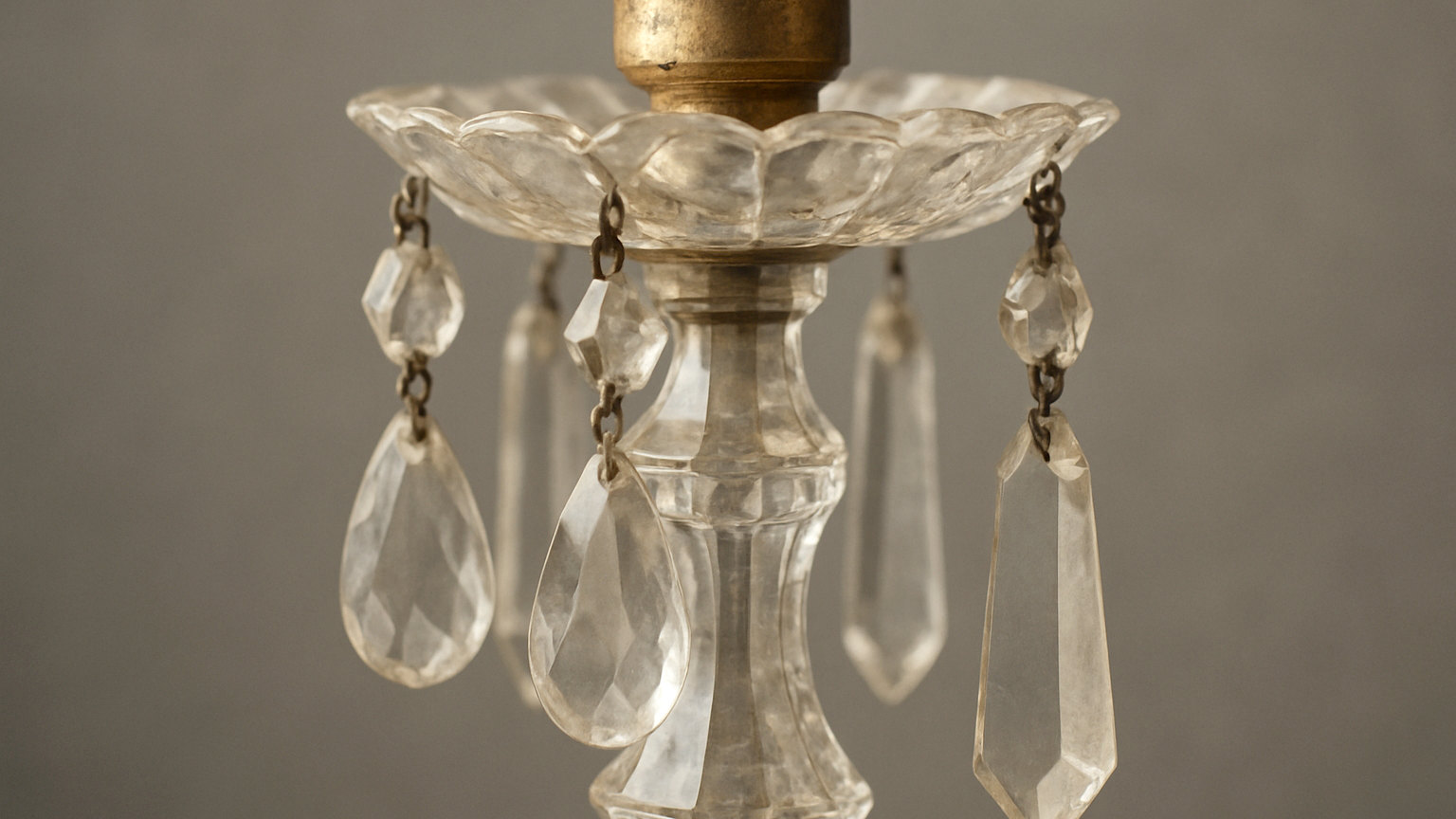
A table candlestick or vase form hung with cut glass drops that catch and refract candlelight. They were made in pairs to stand on a mantelpiece or a sideboard.
The drops are the whole point, and a lustre missing half of them has lost most of its effect and much of its value. Count them, check they match in size and cut, and look for empty hooks where drops have gone.
How are the components joined?
By a metal rod running through the centre, or by a glass join made while the components were hot, or on some pieces by a threaded fitting.
Look at where the stem meets the foot and where the nozzle meets the stem. A visible join is normal on many forms. What matters is whether the parts are original to each other and whether any join has been repaired, which frequently shows as a slightly different tone or a visible line of adhesive.
What should you check on the nozzle?
That it is present, original and undamaged. The nozzle is the socket the candle sits in, frequently detachable and frequently missing.
Check the rim for chips, which are extremely common since candles were pushed in and levered out. Compare the cut pattern and the glass tone against the rest of the piece, since replacement nozzles rarely match exactly.
How do you assess the drops?
By comparing them against each other. Original drops from one piece were cut together and should match in size, shape, thickness and the tone of the glass.
Hold several up to a light together. Replacements are frequently brighter and more optically perfect than originals, which may carry a faint grey or straw tint. Check each drop for chips at the hole, where the wire passes through and where stress concentrates.
What holds the drops on?
Small wire hooks or pins passing through a hole drilled in the top of each drop. These corrode, straighten and break, which is how drops are lost.
Check every hook for corrosion and for replacement with modern wire, which is acceptable and easily done. Look at the holes in the drops themselves for cracks radiating outward, since a cracked hole will eventually fail.
Why do pairs matter?
Because these were made in pairs and a genuine pair is worth substantially more than two singles. They were designed to flank something.
Compare height, the profile of the stem and foot, the cut pattern and the drops. Assembled pairs occur regularly. Check the number of drops on each, since a pair with matching complements is a considerably better proposition than one with different counts.
How do you check condition?
By light and by touch. Hold the piece up to a strong light and turn it slowly, looking for internal cracks appearing as bright lines, particularly at the joins.
Run a fingertip around the foot rim and the nozzle rim feeling for chips. Check the foot for a ground down edge, which indicates damage removed and leaves the piece slightly shorter and the proportions subtly wrong.
Can missing drops be replaced?
Yes, and matching them well is the difficulty. Specialist suppliers hold antique and reproduction drops and will match by size and pattern if you take an original with you.
Budget for it before buying, since a lustre missing many drops may cost more to complete than it did to purchase. A piece with its full original complement commands a real premium precisely because of this.
How should they be handled?
By the stem or foot, never by the drops, and never by lifting a lustre with the drops swinging. Remove drops before moving anything any distance.
Photograph the arrangement before dismantling, since drops were frequently graduated in size and putting them back in the wrong order spoils the effect. Wash drops individually in lukewarm water, never hot, and dry them before rehanging.