Decanters are among the most commonly encountered antique glass and among the easiest to buy badly. Two faults account for most disappointment, and both take seconds to check: a stopper that does not belong, and an interior that has gone permanently cloudy. Neither shows in a photograph.
Why does the stopper matter so much?
Because a decanter without its original stopper is worth a fraction of a complete one, and matching a replacement is genuinely difficult. Stoppers were ground individually to fit their own neck.
That grinding means each stopper fits one decanter and no other. A stopper that sits too high, too low, rattles or binds is not the original. Check by inserting it fully and looking at how it seats, then turning it gently to feel whether the ground surfaces match.
How do you tell if a stopper is original?
By the fit and by the numbers. Many decanters and their stoppers were scratched with matching numbers on the ground surfaces, so check the base of the stopper peg and the inside of the neck for faint scratched numerals.
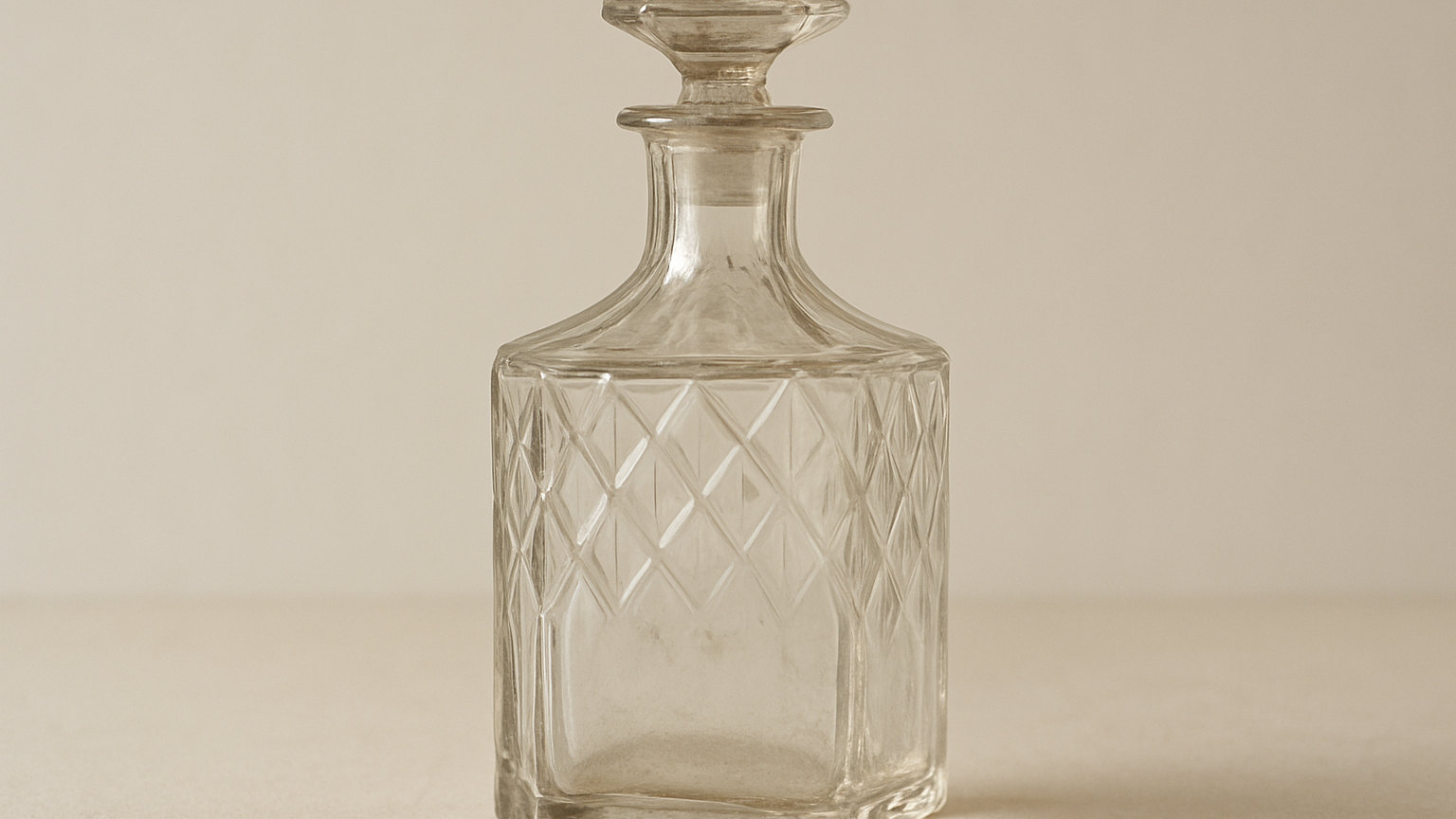
Compare the glass as well: the stopper should match the decanter in colour, in the character of the metal, and in the style and quality of any cutting. A stopper cut in a different pattern from the body has almost certainly come from elsewhere.
What is decanter sickness?
Permanent cloudiness of the interior, caused by liquid left standing for long periods etching the glass surface from within. It appears as a milky haze or as a distinct tide mark.
It cannot be washed out because it is damage to the glass rather than a deposit on it. Professional treatment by polishing the interior exists but is expensive and not always successful. Always hold a decanter up to a window and look through it before buying, since sickness is invisible in most photographs.
How do you check for it properly?
Fill the decanter with water and look through it. Water fills the etched surface and temporarily reduces the haze, so a decanter that clears when wet and clouds when dry has sickness rather than dirt.
Dirt and dried deposits can be removed; etching cannot. Look particularly at the shoulder and the base, where liquid sat longest. A faint tide line at one level is the classic sign of something left standing for years.
How do you date a decanter?
By shape, by decoration and by the base. Body forms moved through recognisable sequences, from tall tapering shapes through broader shouldered forms to squatter designs.
Check the base for a pontil mark, rough or polished, which indicates hand blowing. Look at whether decoration is cut, with crisp polished facets you can feel, or moulded, with softer rounded edges and a mould seam. Neck rings, the applied bands around the neck, vary in number and profile and are a dating feature.
What should you check on condition?
Chips to the rim and to the stopper, and internal cracks. Run a fingertip carefully around the top edge, which is where damage concentrates, and around the base rim.
Hold the piece to a light and turn it slowly, looking for cracks appearing as bright lines. Check the neck for cracks radiating from the rim, which is where a tight stopper puts stress. A ground down rim, indicating damage removed, shows as a rim thinner or more uneven than it should be.
How should a decanter be looked after?
Emptied, washed and dried thoroughly after every use, and stored with the stopper out. Leaving liquid standing is what causes sickness, and leaving the stopper in traps moisture and can seize it in place.
Wash by hand with warm water and mild detergent, never in a dishwasher. Dry the interior completely, which is best done by leaving it upturned and open. Store stoppers alongside rather than inserted, and never force a stuck stopper, since twisting breaks necks.