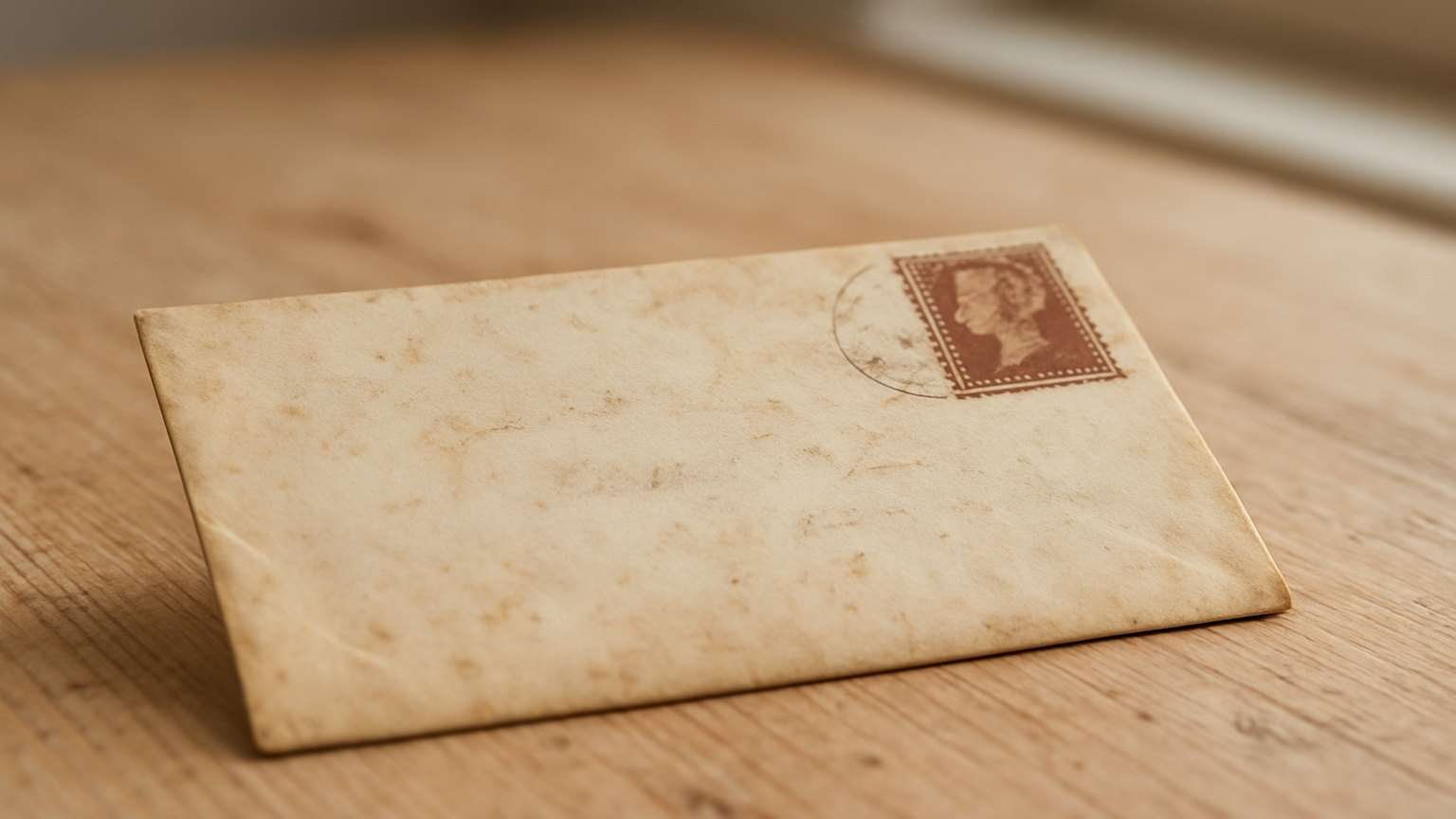
Most people who inherit old letters see stamps on envelopes and think about soaking them off. In a great many cases the envelope is worth considerably more than the stamp, and separating the two destroys the value permanently. Postal history is the field that collects the whole item, and it is worth understanding before anything goes near water.
What is postal history?
The study and collection of how mail actually travelled, using complete envelopes and letters as the evidence. The stamp is only one element among several, and frequently not the most important.
A collector in this field wants the postmarks, the routing marks, the rate markings, the handstamps applied along the way, and the letter itself. Together these document a journey, which is what is being collected rather than the adhesive that paid for it.
What is a cover?
The envelope or wrapper that carried a letter, complete with its stamps and markings. An entire is a letter sheet folded and addressed without a separate envelope, which is how mail travelled before envelopes became usual.
Both terms describe complete items. A front is just the address side, with the rest removed, and is worth considerably less because the reverse carried transit and arrival marks. Completeness is the whole point of the category.
What makes a cover valuable?
The route, the rate and the markings rather than the stamp. Mail that travelled an unusual way, that was carried by a particular ship or railway, or that passed through a small office with a scarce postmark all attract collectors.
Early dates matter, especially covers from the first period of adhesive postage. Unusual rates, forwarded and redirected mail, undelivered items with instructional markings, and mail connected to an event or a place all add interest. A common stamp on an interesting cover can be worth far more than a scarce stamp alone.
Why is soaking so destructive?
Because it separates the stamp from everything that gave it context. Once removed, the stamp is worth its catalogue value as a used example, which is frequently a very small sum, and the cover is worth almost nothing.
The cancellation is part of the evidence too. A postmark tying a stamp to a cover, where the mark runs across both, is what proves the stamp genuinely travelled on that item. Removing the stamp destroys that tie and the proof with it.
What should you look at on an old envelope?
Both sides, carefully. The front carries the address, the stamp and the cancellation. The reverse frequently carries transit marks from offices the letter passed through and an arrival mark at its destination.
Note the dates on every mark, since together they show how long the journey took and which route it followed. Look for manuscript rate markings written by hand, wax seals, and any instructional handstamps indicating the item was returned, redirected or delayed.
Does the letter inside matter?
Sometimes considerably. A letter describing a notable event, written by an identifiable person, or documenting daily life in a specific place and period adds real interest beyond the postal aspects.
Keep the contents with the cover rather than separating them, and never discard a letter to keep the envelope. Where contents are present the item is more complete and more saleable, and the two belong together as a single object.
How should covers be stored?
Flat, in inert sleeves, out of light and away from damp. Paper is vulnerable to everything, and old envelopes are frequently fragile at the folds.
Do not flatten a folded entire that has been folded for two centuries, since forcing it can split the paper along the crease. Never repair a tear with adhesive tape, which stains permanently and is extremely difficult to remove. If an item matters, take it to a paper conservator rather than attempting anything yourself, since paper repairs need reversible adhesives and matched fibres that are not available domestically.