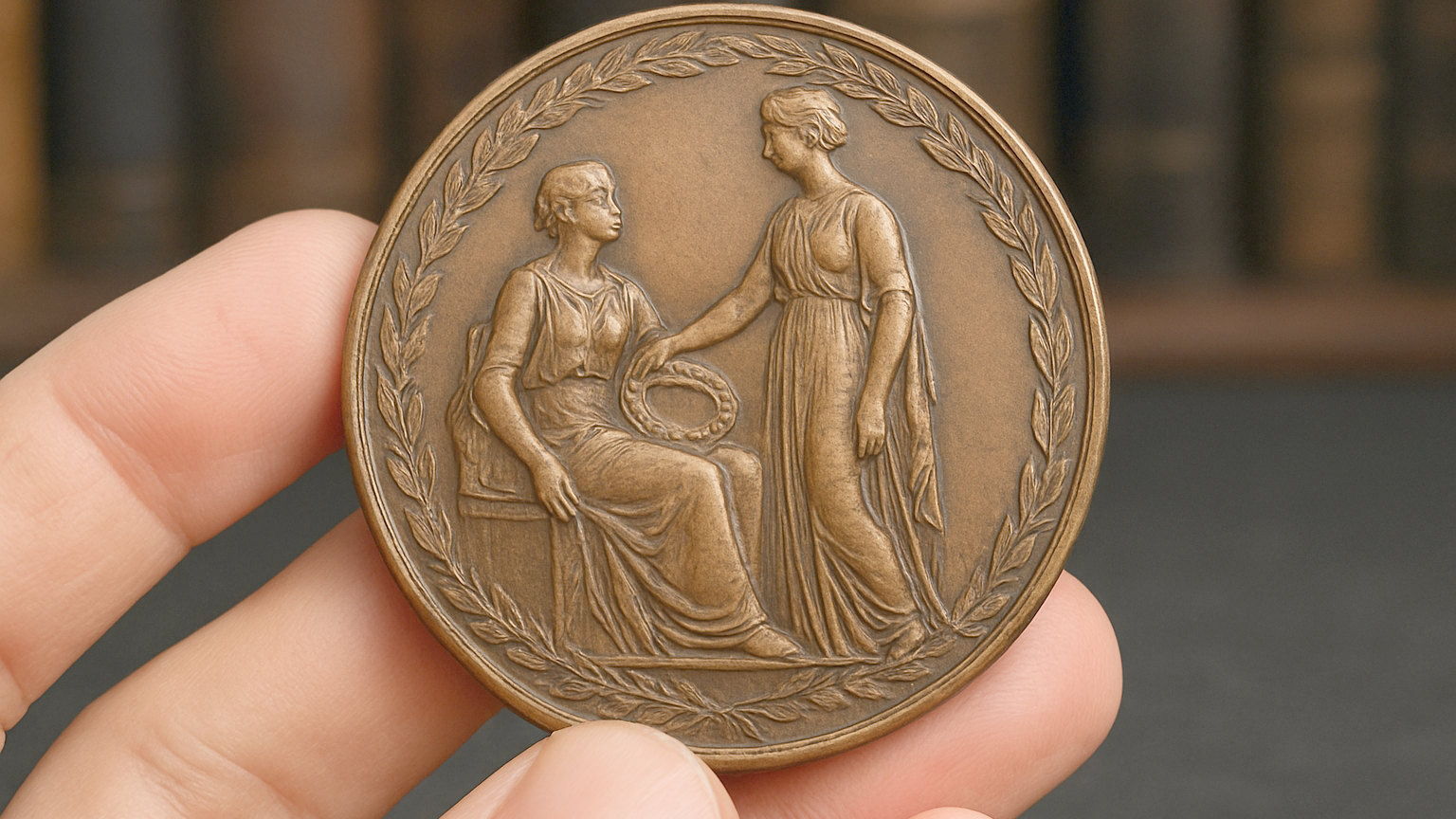
Not every medal was awarded to somebody. A large category exists purely to commemorate events, mark exhibitions, award prizes and celebrate anniversaries, and these are identified quite differently from campaign medals because there is no recipient name and no medal roll to consult.
How do these differ from campaign medals?
They are not awarded for service and are almost never named around the rim. They commemorate an event or recognise an achievement, and they were frequently sold to the public rather than issued.
That means identification rests entirely on the design and the inscription on the faces. There is no service record to trace and no entitlement to verify, which makes the research quite different in character.
What kinds are there?
Exhibition medals from international and trade exhibitions, prize medals from agricultural and industrial societies, coronation and jubilee medals, and medals commemorating buildings, openings, treaties and disasters.
Also art medals produced as sculpture in their own right, and society medals awarded for achievement in a field. Each has its own collector base, and identifying which category a piece belongs to determines where to look for references.
How do you identify one?
By reading everything on both faces and the edge. The inscription usually names the event, the year and frequently the issuing body, which is most of the identification.
Look for the engraver signature, usually small and near the truncation of a portrait or at the base of a design. Engravers are documented and their working periods known, so a signature dates and attributes a medal precisely.
What does the metal tell you?
Frequently the level of award. Prize medals were commonly issued in gold, silver and bronze for different placings, with the same dies used for all three.
So an identical design in different metals is normal rather than suspicious, and the metal determines both the rarity and the value. Gold examples are far scarcer. Check whether a bronze medal has been gilded later, which shows as wear revealing bronze at the high points.
What about the edge?
Worth reading carefully, since prize medals frequently carry the recipient name and the award engraved around the edge even though the medal was not named at manufacture.
That engraving turns a generic medal into a documented one and adds interest and value, particularly if the recipient can be traced. Look also for a metal mark indicating silver, and for any maker or mint mark.
Does the case matter?
Considerably. Better medals were issued in fitted cases, frequently leather covered with a silk and velvet lining, and the case may carry the issuing body name or the retailer.
A medal in its original fitted case is worth substantially more than the same medal loose, and the case sometimes carries information the medal does not. Check the fit is exact rather than approximate, since married cases occur.
What drives the value?
Subject, metal, scarcity, condition and the engraver. Medals commemorating events that people collect, or connected to a place or industry with a following, do best.
Artistic quality matters in its own right, since medallic art is collected as sculpture. Condition matters as with any struck piece, and cleaning damages a medal exactly as it damages a coin, so an original patinated surface is preferred to a polished one.
How should they be kept?
In their original cases where these survive, or in inert holders, stored dry and handled by the edges only. Bronze and copper alloy medals are susceptible to the same active corrosion as coins.
Never clean or polish them, since patina is expected and valued and cleaning is treated as damage. Watch for pale powdery green spots, which indicate active corrosion, and isolate any affected piece immediately since it can spread to others stored alongside.
How do you research one?
By searching the event and the year from the inscription, then the issuing body, then the engraver signature. Each narrows the field further.
Published references catalogue medals by subject and by engraver, and museum collections hold extensive medallic holdings that are searchable and reliably attributed.