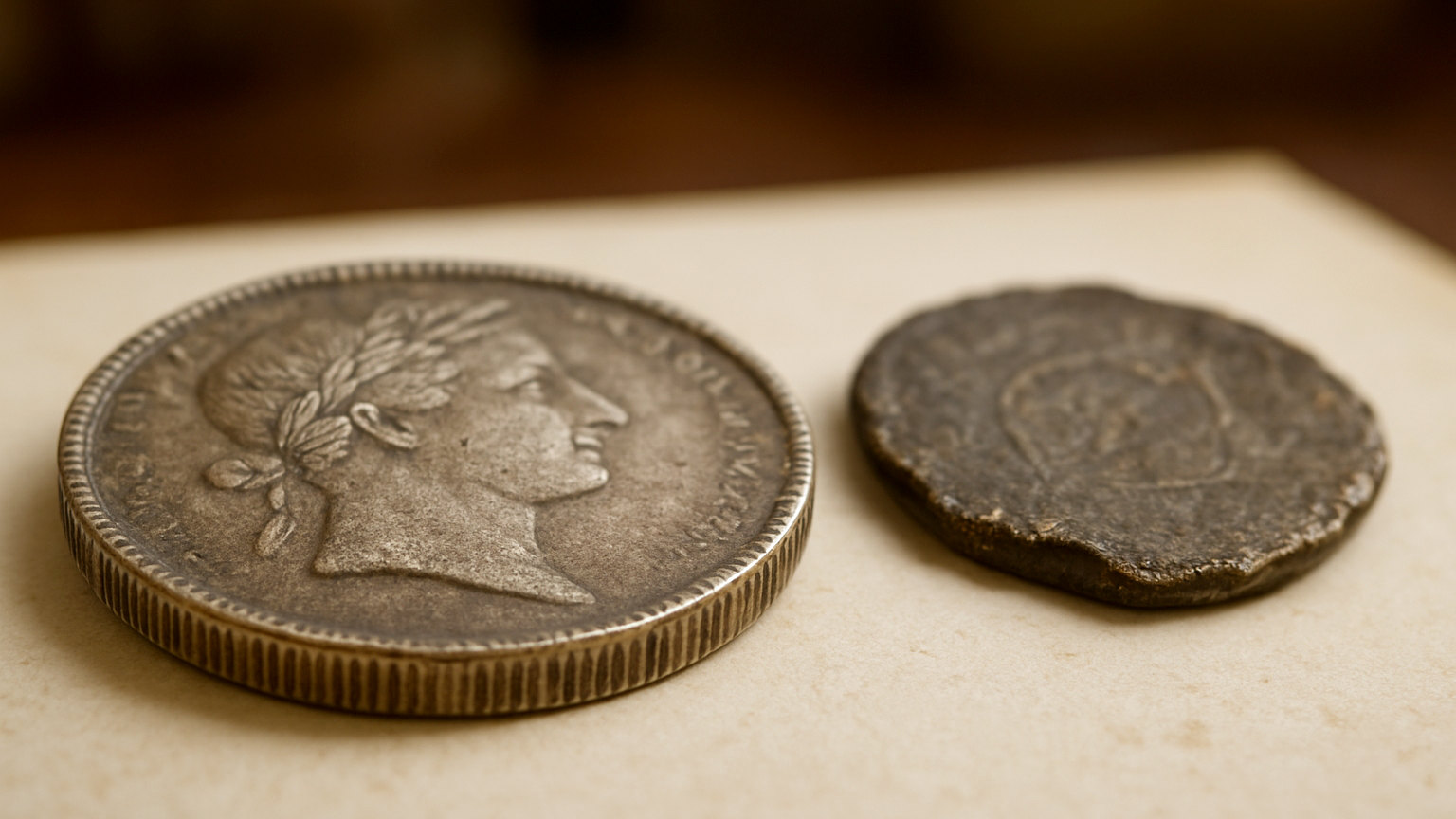
Milled coinage replaced hand hammered striking and changed almost everything about how coins look. They are round rather than irregular, evenly struck, and crucially they carry a treated edge. That edge was not decoration. It was a security measure, and understanding why explains most of what you need to know about the transition.
What does milled mean?
Struck by machine rather than by hand. A press applies pressure evenly to a blank held in a collar, producing a perfectly circular coin of consistent diameter and thickness with a sharply defined design.
The term derives from the mill that powered the early machinery. The practical result is that every coin from a given die looks essentially identical, which is the opposite of hammered coinage where no two are alike.
Why does the edge matter?
Because it stops clipping. Silver and gold coins were routinely shaved around the edge to steal metal, and a coin with a plain smooth edge gave no way to tell whether it had been trimmed.
A grained or lettered edge solves this completely. Remove any metal and the treatment is interrupted, which is immediately visible. This is why edge treatment appeared alongside machine striking, and why an edge that looks disturbed on a milled coin is a serious warning.
What kinds of edge are there?
Grained or reeded edges carry fine vertical grooves around the circumference, which is the arrangement most modern coins still use. Lettered edges carry an inscription running around the edge, usually a motto sometimes with a date.
Some coins have decorated edges with repeating patterns rather than letters. Read a lettered edge by rolling the coin slowly under a light, since the letters are shallow and only catch at certain angles. Note whether the lettering runs clockwise or anticlockwise, since that varies and is sometimes diagnostic.
How do you tell milled from hammered at a glance?
Shape and evenness. A milled coin is truly round with a consistent diameter, the design is centred, and the strike is even across the whole face. Hammered coins are irregular, frequently off centre, and often have part of the legend running off the flan.
Thickness is the other clue. Milled coins have uniform thickness because the blank was held in a collar. Hammered flans vary noticeably from one side to the other, which you can feel by rolling the coin between finger and thumb.
What should you check on the edge?
That it is undisturbed all the way round. Look for a section where the graining stops or the lettering is interrupted, which indicates metal has been removed or the coin has been mounted at some point.
Mounting damage is very common on gold coins used as jewellery. Even where a mount has been removed skilfully, the edge usually shows filing marks or a flattened section, and the coin is treated as damaged rather than graded normally. Check for solder traces as well.
How is a milled coin dated?
Usually by the date on the face, which is the great convenience of milled coinage. Where a date is present, the remaining work is identifying the denomination, the metal and any variety.
Mint marks, initials of the engraver, and small differences between dies all separate varieties within one year, and some of those varieties are far scarcer than others. Check reference catalogues for the specific type rather than assuming all coins of that date are equal.
What affects value most?
Grade, as always, followed by scarcity of the particular date and variety. Original surfaces and mint lustre command a substantial premium, and cleaning destroys both permanently.
Edge damage, mounting marks, scratches and any tooling place a coin outside the normal grading scale entirely. Handle coins by the edges only, store them in inert holders away from damp, and never clean one regardless of how dirty it appears, since the loss in grade is always larger than any gain in appearance.