Hammered coins were struck by hand between two dies, one blow at a time, which is why no two are quite alike. They are irregular in shape, often off centre, frequently clipped around the edge and almost never dated. Identifying one means reading a set of clues rather than looking up a year, and the process is genuinely enjoyable once you know the order to work in.
How were hammered coins made?
A blank disc of metal was placed on a fixed lower die, an upper die was held on top, and the workman struck it with a hammer. One blow, sometimes two, produced the coin.
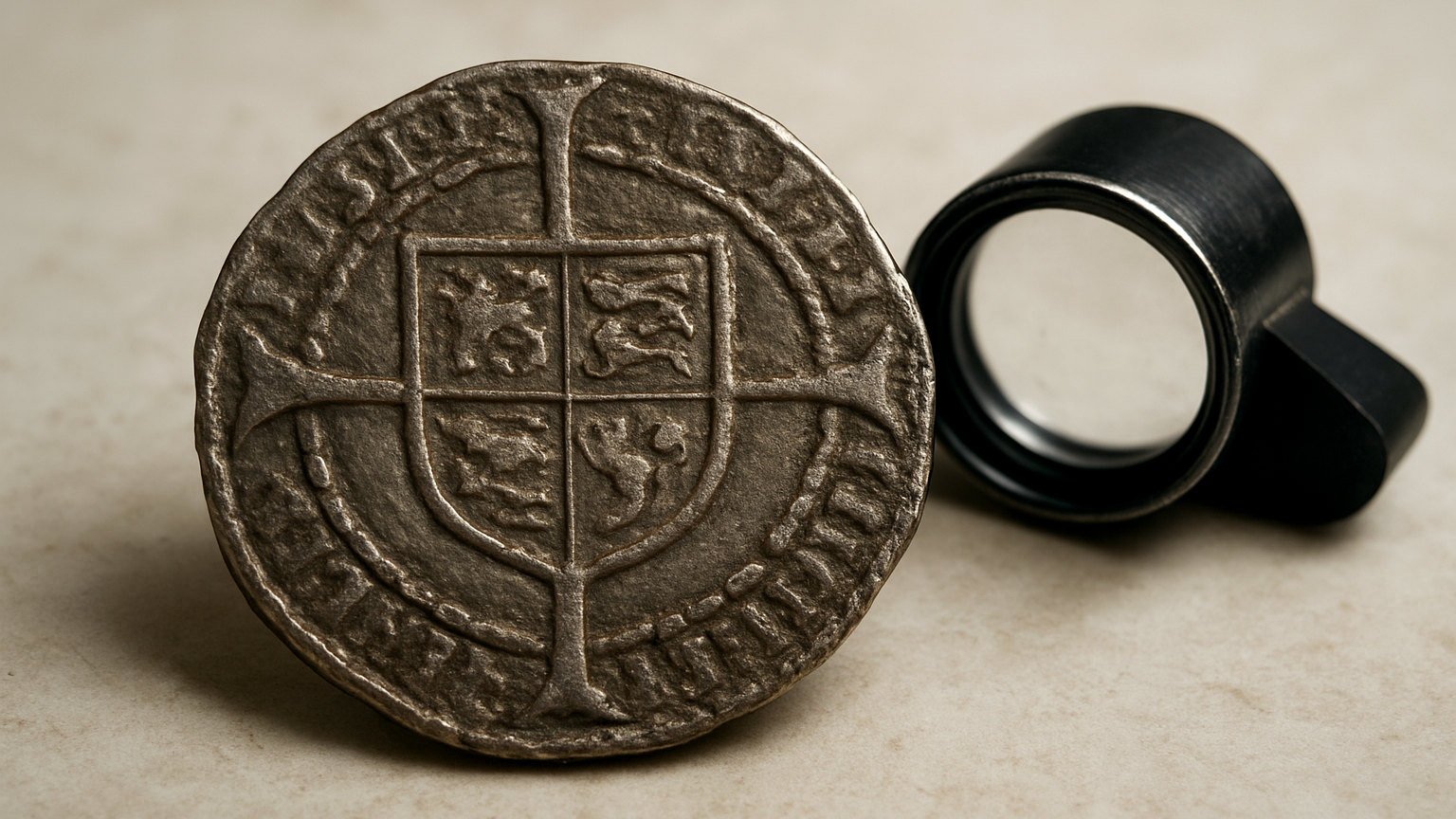
That method explains every characteristic of the finished object. The design is rarely centred, part of the legend often runs off the edge, the flan is uneven in thickness, and the shape is roughly rather than exactly round. These are normal features rather than faults, and a perfectly round, evenly struck example is unusual and desirable.
What should you read first?
The legend, meaning the inscription running around the edge of each face. It usually gives the rulers name and titles in abbreviated Latin, and that name is the fastest route to a reign.
Read what survives rather than expecting the whole. Legends are commonly incomplete because the strike missed part of the flan or the edge has been clipped. Even three or four letters in the right position can identify a ruler when combined with the portrait style.
What does the portrait tell you?
More than you might expect, though it is stylised rather than a likeness. Portrait conventions changed between reigns and within them, covering whether the head faces left or right, whether it is shown in profile or facing, and the form of the crown.
Compare against reference plates for the period rather than judging by impression. The style of the crown, the treatment of the hair and the presence or absence of a sceptre or other emblem are all diagnostic features that catalogues use to separate issues within a single reign.
What is a mint mark?
A small symbol, usually at the start of the legend, identifying where and roughly when a coin was struck. Different mints operated in different towns, and marks were changed periodically.
Because those changes are documented, a mint mark frequently narrows a coin to a period of a few years within a reign, which is as close to a date as most hammered coinage gets. The mark may be a rose, a cross, a letter, a star or another small device, and it is worth locating before anything else once you have the ruler.
Why are so many coins clipped?
Because they were silver and their value lay in their metal. Shaving slivers from the edge of a coin yielded silver that could be melted, and the coin still passed at face value if it looked roughly right.
Clipping was widespread and heavily punished, and it is why so many surviving hammered coins are smaller than they should be with legends cut through. A clipped coin is worth less than a full flan example of the same type, and weight is one of the checks used to assess how much has been lost.
How is condition judged?
Differently from milled coinage, and more forgivingly. Because the striking process was crude, the standard is what a good example of that type actually looks like rather than an abstract ideal.
Assess how much of the legend is readable, how well centred the strike is, whether the portrait detail survives, and whether the flan is full and round. A sharply struck coin with a complete legend commands a substantial premium. Cracks in the flan, from the hammer blow, are common and tolerated.
What should you never do?
Clean it. This applies with even more force to hammered coins than to later ones, because the surfaces are soft, the detail is shallow and the toning that has developed over centuries is part of what collectors value.
Soil can be removed by soaking in distilled water with no rubbing whatsoever, and nothing more should be attempted. Handle by the edges, store in inert holders away from damp, and take anything you cannot identify to a dealer or a numismatic society exactly as you found it.