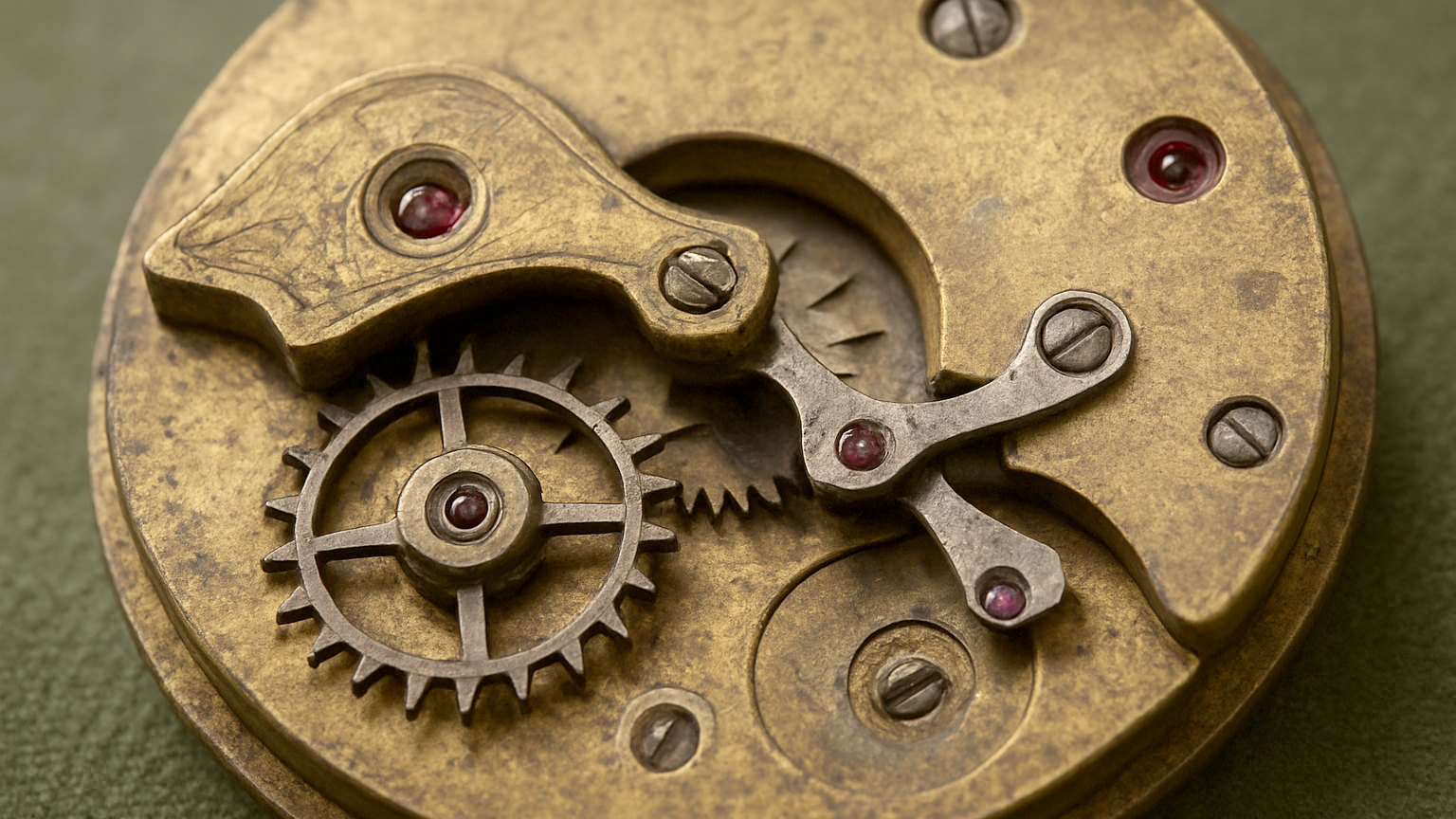
Every mechanical watch contains an escapement: the component that releases the driving power in measured steps and pushes the balance to keep it swinging. It determines accuracy, it is the most refined part of the mechanism, and its type places a movement in a period more reliably than any decorative feature.
What does an escapement do?
Two things at once. It allows the wheel train to advance by a controlled amount for each oscillation of the balance, which produces the tick, and it delivers an impulse to keep the balance moving against friction.
Without it the mainspring would unwind in seconds. The quality of that impulse and how little it disturbs the balance is what determines whether a watch keeps time well or poorly, which is why escapement design improved steadily.
What is a verge escapement?
The earliest in common use, employing a crown wheel with saw shaped teeth engaging two pallets on a vertical staff. It is recognisable by the crown wheel turning in a vertical plane.
Verge watches are deep front to back, have a domed balance cock and require a wide swing of the balance. Timekeeping is poor by later standards and no amount of servicing changes that, since the limitation is in the design rather than the condition.
What is a cylinder escapement?
An improvement using a hollow cylinder on the balance staff, into which the escape wheel teeth enter and leave. It allowed much flatter watches than the verge permitted.
Cylinder watches are noticeably slimmer, which was their commercial appeal. The cylinder itself is fragile and wears, and a worn cylinder is expensive to replace, so check that a cylinder watch runs before buying one as anything other than a case.
What is a lever escapement?
The arrangement that eventually became standard, using a pivoted lever between the escape wheel and the balance, which delivers impulse cleanly and lets the balance swing freely between impulses.
It is considerably more accurate than either earlier type and is what almost all later watches use. Jewelled pallets on the lever indicate better quality. An English lever with a well finished movement is a genuinely fine thing at a modest price.
How does the escapement date a movement?
By giving a broad period, since each type superseded the last. Finding a verge indicates early work; finding a lever indicates later.
Be careful, though, since cheaper watches continued using obsolete escapements long after better ones existed. Use the escapement alongside other evidence: the case hallmark dates the case precisely, and the movement style and serial number narrow it further.
What is a conversion?
A movement originally built with one escapement and later altered to another, usually to improve timekeeping. It was done frequently and it reduces value considerably.
Look for filled or redundant holes in the plates, a top plate that has been cut or patched, and components whose finish does not match the surrounding work. Collectors want original configuration, and a converted movement is worth noticeably less than an untouched one.
What should you check before buying?
That the escapement is complete and running, and that the balance swings freely when the watch is gently rocked. A balance that does not move indicates a problem in exactly the most expensive part.
Look at the balance spring for kinks and distortion, and at the jewels for chips. Have anything significant examined by a watchmaker before committing, since escapement parts for early movements frequently have to be made by hand.
How should an escapement be treated?
Left to a watchmaker entirely. It is the most delicate part of the movement and the least forgiving of amateur attention.
Never oil an escapement yourself, never attempt to adjust a balance spring, and never run a watch that has stood for decades without a service, since dried lubricant in the escapement causes wear that is expensive to correct.
Does it affect what a watch is worth?
Substantially. A jewelled lever movement with good finishing is worth considerably more than a rough cylinder, and an original verge in an early watch attracts collectors specifically.
Buy the movement rather than the case, which is the general rule in watches. Learn to recognise the three main types by sight, and the field becomes far easier to navigate than it first appears.