A pocket watch has two datable elements that were often made by different people: the movement inside and the case around it. The case is the easier of the two, because precious metal cases carry a full hallmark giving the exact year. Comparing that year against the movement is one of the most useful checks in the whole field.
Where are the case marks?
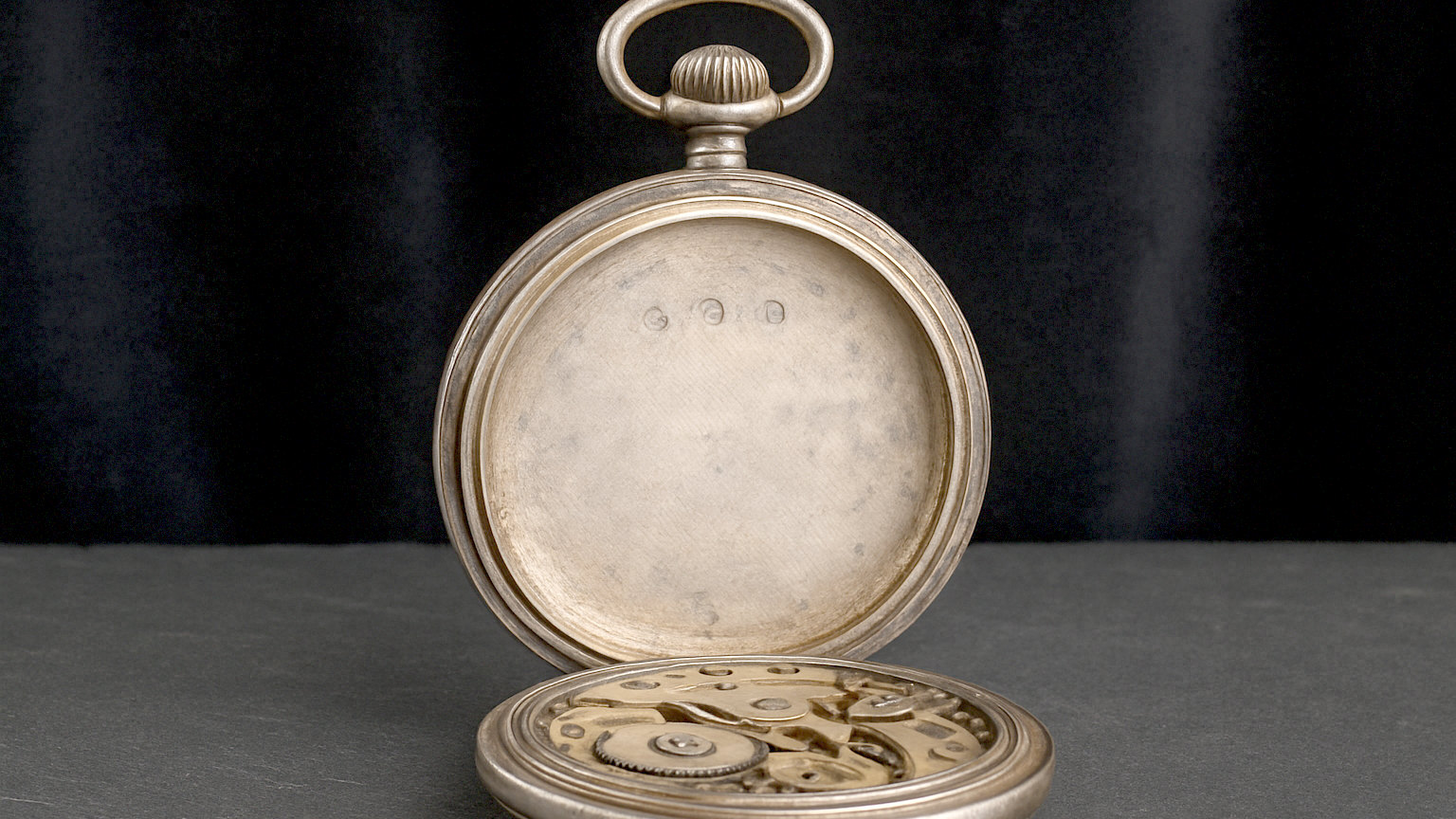
Usually inside the back cover, and frequently repeated on the inner dust cover where one is fitted. Open the back and look at the inner surface, holding it at an angle under a good light.
On some cases the marks are on the band, the strip forming the side of the case. Check the bezel and any separate covers as well, since each part should be marked in its own right. Marks are often small and worn, so photograph rather than straining to read them directly.
What do the punches mean?
The same as on any British silver or gold: a standard mark showing the purity, a town mark for the assay office, a date letter giving the exact year, and a makers mark identifying whoever submitted the case.
Read the town mark first, then look up the date letter in that office table, since the alphabets were not synchronised between offices. Gold cases carry a numeric standard indicating the carat rather than a lion, and both gold and silver cases were made in enormous numbers.
Who is the maker mark?
The casemaker, not the watchmaker. Cases were a separate trade, and a specialist workshop made cases for many different watchmakers.
That means the initials inside the case will usually differ from the name on the movement, and this is entirely normal rather than a warning sign. Casemakers are recorded in reference works, and identifying one occasionally helps establish where a watch was finished.
How do you check the case belongs?
Compare the hallmark year against the movement serial number. Movement serial numbers can be dated through published records for most established makers, and the two figures should be close.
A gap of a year or two is normal, since cases and movements were made separately and stocked. A gap of decades means the movement has been recased, which is extremely common and reduces value. Check also whether the movement sits neatly in the case, since an ill fitting movement with packing or extra screw holes has been moved.
What if there is no hallmark?
The case is probably not precious metal. Gold filled and rolled gold cases have a thin gold layer over base metal and cannot be hallmarked, so they carry manufacturer marks and sometimes wording describing the plating instead.
Look at the wear points on the edges and around the bow. Gold filled cases show a brassy or greyish base metal breaking through at high points with a fairly defined edge. Nickel and other base metal cases were made in huge numbers and are worth far less, though the movement inside may still be good.
Do case marks affect value?
Considerably, in two ways. A precious metal case has intrinsic value on top of the watch, and a case original to its movement is worth substantially more than a later replacement.
Presence of clear legible marks also adds certainty, which buyers pay for. A watch that can be dated exactly, with a case demonstrably contemporary with its movement, sells more easily and for more than one that leaves questions open.
What should you avoid doing?
Polishing. Case marks are shallow and wear quickly, and repeated polishing rounds the punch edges until they cannot be read. The dark residue sitting in the recesses is what makes them legible.
Do not force a stiff case back, since that scratches the case and can spring the hinge. If it will not open with a thumbnail in the lip, leave it to a watchmaker who has the correct tools, rather than working at it with a knife blade.