Watch chains turn up constantly, usually detached from whatever watch they served, and they are among the items most often sold by weight without being looked at properly. A great many are rolled gold rather than solid, and a good number of the solid ones are worth considerably more as period jewellery than as metal.
What is an Albert chain?
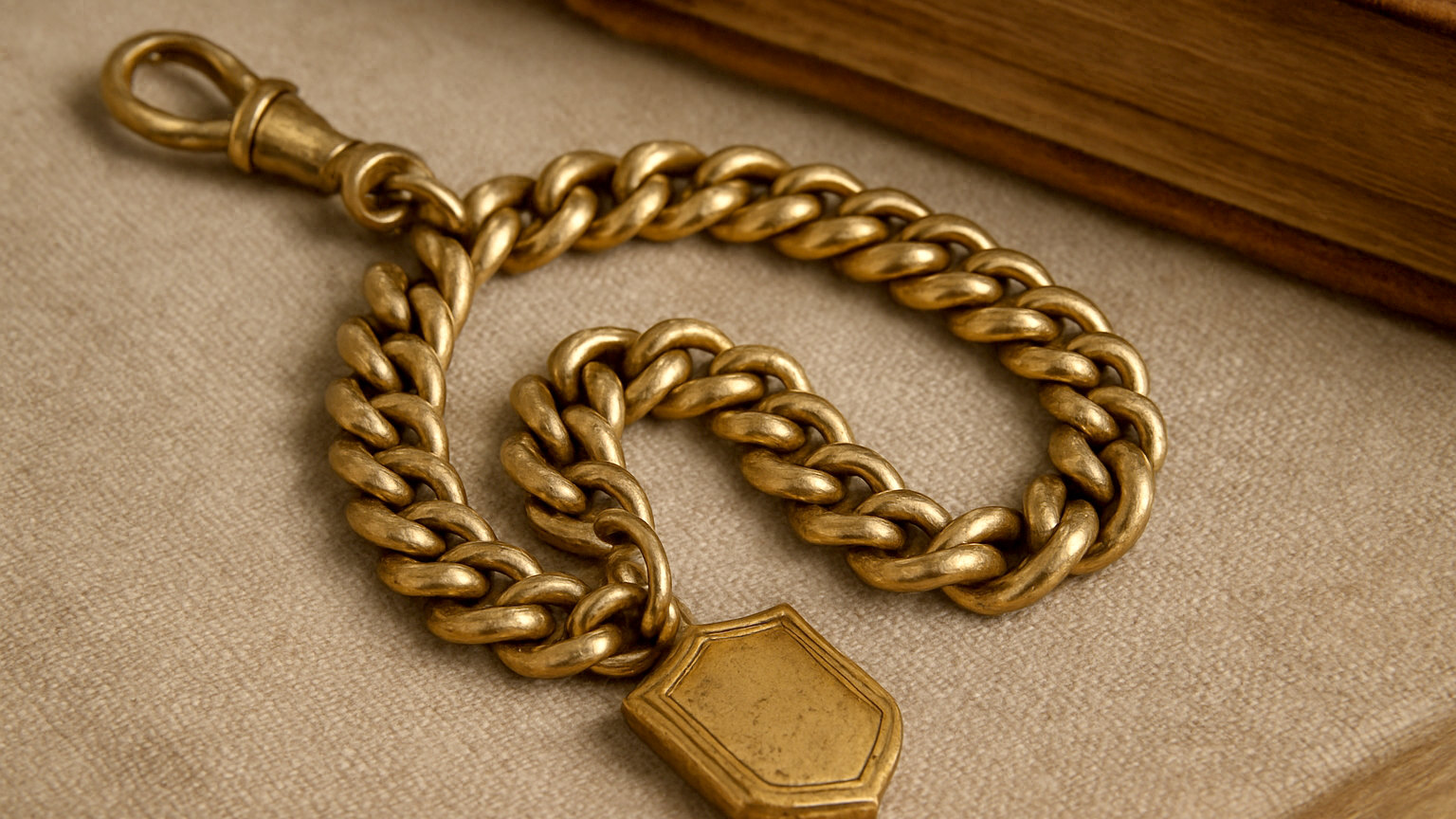
A short chain worn across a waistcoat, with a bar at one end to pass through a buttonhole and a clip at the other to attach the watch. A double Albert has a chain running to each side, one for the watch and one for a fob or a sovereign case.
The form is the commonest surviving type by a wide margin. Length matters: a chain must be long enough to reach comfortably from buttonhole to pocket, and a chain that has been shortened is worth less.
What is a fob?
An ornament hung from the chain, which may be a seal, a medal, a coin mount, a compass, a cigar cutter or a decorative pendant. Some are functional, most are decorative.
Fobs are collected in their own right and a good one adds real value to a chain. Seals with engraved crests or initials are particularly sought, since they can sometimes be traced. Check any fob for its own marks separately, since it may be a different metal from the chain.
How do the fittings date a chain?
By type and construction. Swivel clips with a rotating loop, dog clips with a sprung lever, and simple spring rings all belong to recognisable periods and improved over time.
Look at whether fittings are hand made, showing slight irregularity and a soldered join, or manufactured and perfectly uniform. The T bar or toggle at the buttonhole end is also informative, since its form and how it attaches varied. A modern lobster clasp on an old chain is a replacement.
How do you tell solid gold from rolled gold?
By examining the wear points, which is where the answer always shows. Rolled gold has a genuine gold layer bonded over a base metal core, and it wears through at the high points after decades of use.
Look at the links where they rub against each other and at the fittings, which take the most handling. A duller, greyer or pinker patch with a fairly defined edge means the gold layer has worn through. Solid gold wears smooth without changing colour.
Where should you look for marks?
On the clasp, the swivel, the T bar, and on individual links near the ends. Some chains carry a tiny stamp on a single link, easily missed without magnification.
Many are entirely unmarked because individual links fell below the weight thresholds for compulsory marking, so absence proves nothing. Where no mark is found, have the chain tested electronically by a jeweller rather than assuming either way.
How do you assess the links?
By looking for hand work. Early links were formed individually and soldered closed, so each varies slightly and the solder join is visible under magnification.
Machine made links are identical with perfectly consistent shape and spacing. Look along a run of ten links: variation indicates hand work and greater age. Check for repairs where a link of different pattern or colour has been introduced, and for links that have opened or worn thin.
Is a chain worth more than its scrap value?
Frequently, and this is where money is lost. Buyers offering by weight ignore workmanship entirely, and a great deal of hand made chain has been melted because nobody looked at it properly.
Chains with decorative links, original swivels and T bars, attached fobs, or any that are unusually long or finely made are worth having assessed by a jewellery specialist. Rolled gold chains have decorative value even though the metal value is small, and should not be scrapped either.
How should one be checked before wearing?
Run it slowly through your fingers examining every link and join, looking for links that have opened or worn thin at the pivot points.
Test the swivel and any clasp by pulling gently but firmly, since worn springs are how watches are lost. Pay particular attention to the links immediately either side of each fitting, which take the most stress, and have anything loose repaired before use rather than afterwards.