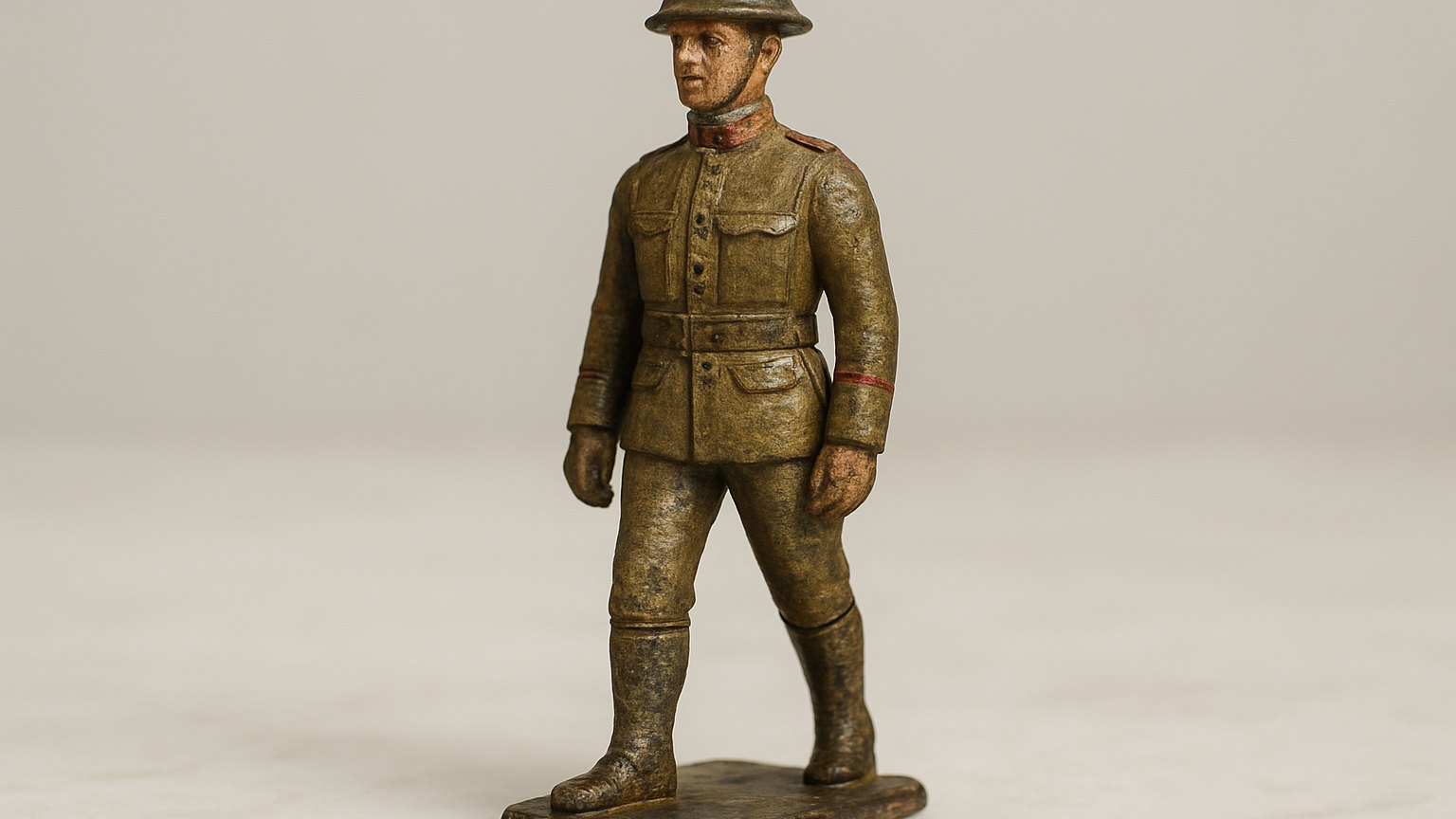
Toy soldiers are a large and well organised collecting field with a vocabulary of its own. Identification rests on how a figure was made, since casting methods differ visibly, and on the base, which frequently carries the maker name. Condition rests almost entirely on whether the paint is original.
What is hollow casting?
A method where molten metal is poured into a mould and the surplus poured out before it sets, leaving a hollow shell. It used far less metal than solid casting and made figures lighter and cheaper.
Turn a figure over and look at the base. Hollow cast figures have an opening underneath where the surplus metal was drained, and the shell is thin enough to be dented. Solid cast figures are heavier with a closed base, and generally earlier or from different traditions.
What are flats and semi flats?
Flats are figures cast in two dimensions, essentially a silhouette with detail engraved on both faces, and they belong to a distinct and long established tradition.
Semi flats have some modelling but remain shallow. Fully round figures are modelled in three dimensions. Each tradition has its own collectors and its own references, so establishing which you have determines where to look for identification.
Where is the maker name?
On the base, usually impressed or cast in as part of the mould, sometimes with a copyright line and a date. Look under raking light, since the lettering is shallow and frequently obscured by paint.
Base shape itself is diagnostic, since manufacturers used characteristic outlines: oval, rectangular, or shaped to the figure. Collectors identify unmarked figures from base shape and casting style alone, and reference works illustrate these systematically.
Why does original paint matter so much?
Because it is essentially all of the value. Figures were hand painted, and a repainted figure is worth a small fraction of an original one however neatly the work was done.
The trade spots repaints immediately through paint thickness, wrong shades and paint where the original process would not have put any. Original paint with honest chips and wear is far preferable to a smooth repaint, and this is the single most important thing to understand about the category.
How do you spot a repaint?
By thickness and by coverage. Factory painting was thin and applied quickly, so fine cast detail such as facial features, buttons and equipment stays crisp beneath it.
Repaints are thicker because they cover existing damage, softening detail and filling recesses. Look for paint on the base where the factory left bare metal, for colours that are close but not right, and for a uniform finish on a figure whose casting shows genuine age.
What is lead rot?
Progressive corrosion of lead alloy figures, appearing as a white powdery deposit and eventually crumbling the metal entirely. It is caused by exposure to organic acids, frequently from unsuitable storage materials.
Oak cabinets, some cardboard, and certain adhesives all release vapours that trigger it. Once established it spreads and is difficult to arrest. Isolate any affected figure immediately, since it can affect others stored alongside, and take advice rather than attempting treatment.
Does the box matter?
Enormously, as throughout toy collecting. Figures were sold in sets in printed boxes, and a complete boxed set is worth several times the same figures loose.
Check the set is complete against the box contents, since figures were lost and substituted constantly. Look for reproduction boxes, which are made for the more valuable sets. The box also confirms exactly which set you have, which matters where similar figures were issued in different combinations.
How should they be stored?
In inert materials, dry, and away from oak and unsealed timber. Acid free tissue and inert plastic trays are safe; ordinary cardboard and oak cabinets are not.
Keep figures separated so paint does not rub, since the paint is the value. Do not clean beyond removing dust with a very soft brush, and never wash, polish or touch in chips. Handle by the base rather than by projecting rifles and limbs, which snap.