Boxed games and puzzles are among the most charming survivals from any nursery and among the most frequently incomplete. They contained many small components, they were played with by children, and the box lid took the wear. Completeness is therefore the whole assessment.
How do you check a jigsaw?
By counting, which is tedious and unavoidable. Early wooden jigsaws were cut by hand and the piece count is frequently printed on the box or the label.
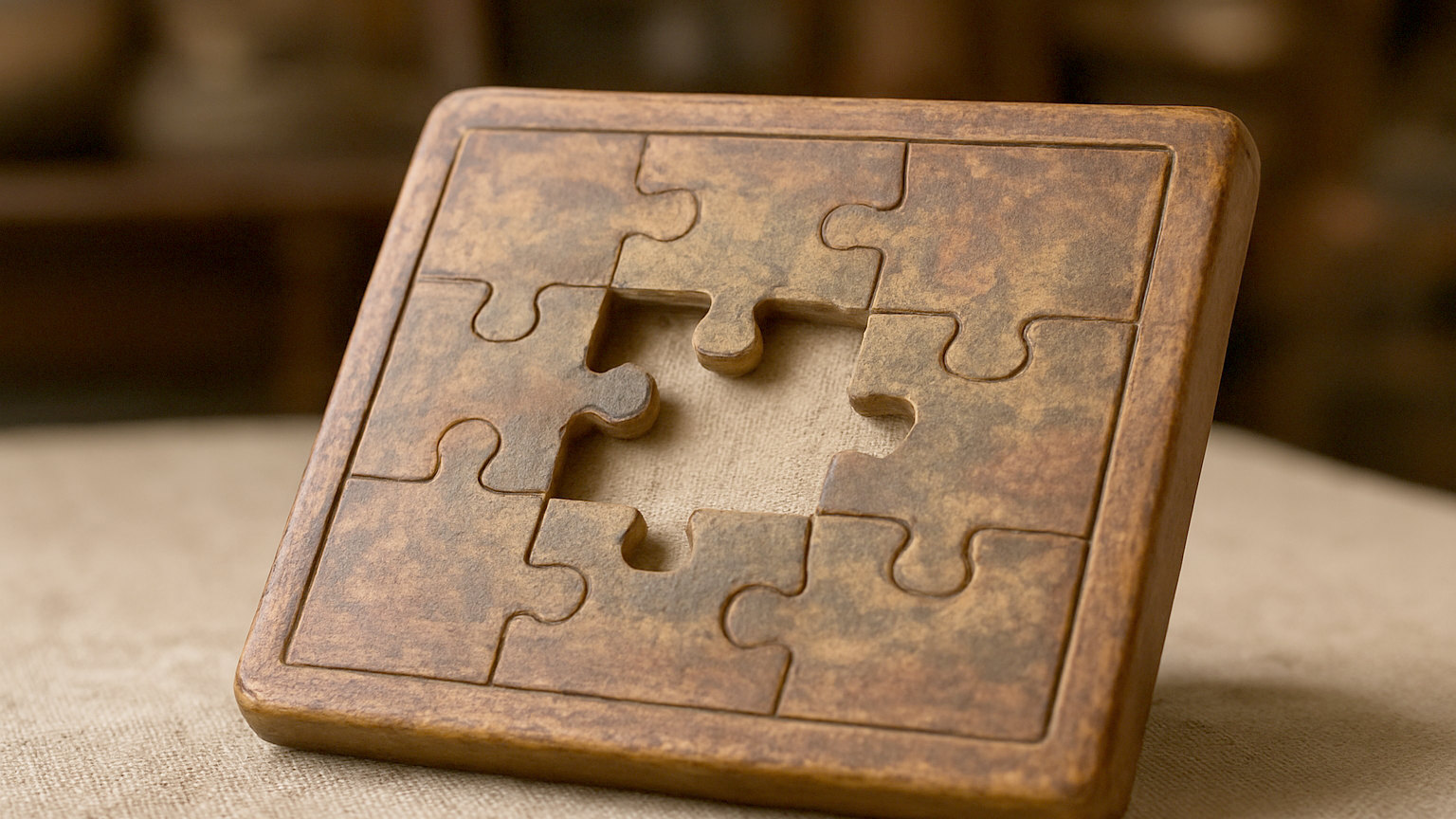
Assemble it if you possibly can, since that is the only way to be certain nothing is missing. A single missing piece reduces value substantially and a puzzle described as complete without having been assembled should be treated cautiously.
How do you date a jigsaw?
By the material and the cutting. Early puzzles were cut from solid mahogany or cedar with a fretsaw, so the pieces are thick, the wood grain is visible on the reverse, and the cutting follows the picture outlines.
Later puzzles use plywood, which shows layers at the edge, and later still cardboard. Interlocking pieces are a later development than plain push fit shapes. The image itself, whether hand coloured, lithographed or photographic, dates it further.
What are the common game types?
Race games played on a printed board with dice or a spinning teetotum, card games, table skittles and bagatelle, and educational games teaching geography, history or morality.
Educational games are frequently the most interesting, since they reveal what children were expected to learn. Map dissections, which are jigsaws of countries or counties, are among the earliest jigsaw forms and are collected in their own right.
What should a complete game contain?
The board, the box, the rules, and every playing piece, counter, dice, spinner or card. The rules sheet is frequently the first casualty and its absence reduces value.
Check the rules against the contents, since they list what should be present. Counters and playing pieces were made in specific numbers and colours, and substituted pieces from other games are common and detectable by material and finish.
Why does the box matter so much?
Because it carries the identification and because it rarely survived well. The lid label gives the title, the publisher and frequently a date, and it took every knock the game received.
Check the label for tears, losses and overpainting, and look at the box corners which split first. A game with a bright complete label is worth considerably more than the same game in a damaged box, and reproduction labels exist.
How do you identify the publisher?
From the box label, the board itself, or the rules sheet, all of which frequently carry a name and address. That address dates the game through trade directories.
Some boards carry a publisher name printed in the border or beneath the playing area. Where nothing survives, the printing method and the style of illustration will place the game within a period even without a name.
What condition issues matter?
Foxing and staining on printed boards and labels, splits along fold lines on folding boards, and warping on wooden pieces stored damp.
Check folding boards along every crease, since the linen backing gives way there first. Look for overpainting on damaged printed areas, which is a form of restoration and should be disclosed. Water damage is common and largely irreversible on paper.
How should they be stored?
Flat, dry and out of light, with the box supported so it cannot crush. Card and paper are the vulnerable components rather than the wooden pieces.
Keep small pieces in a bag inside the box rather than loose, so nothing escapes. Do not use adhesive tape on a box or label, since the residue damages printed surfaces permanently and is very difficult to remove.
Are they worth collecting?
Early hand cut wooden jigsaws, map dissections and educational games attract genuine interest, and complete boxed examples are scarce. Later mass produced games are worth considerably less.
Buy on completeness and on the condition of the printed surfaces, since those are what cannot be remedied. Check the piece count before agreeing anything, and treat any game described as probably complete as incomplete until proven otherwise.