Teddy bears are among the most valuable toys in the market, and the difference between an early bear and a later one can be enormous. Fortunately the shape changed in ways that are visible at a glance, because early bears were modelled on real bears while later ones became progressively rounder and more cartoonlike.
What shape is an early bear?
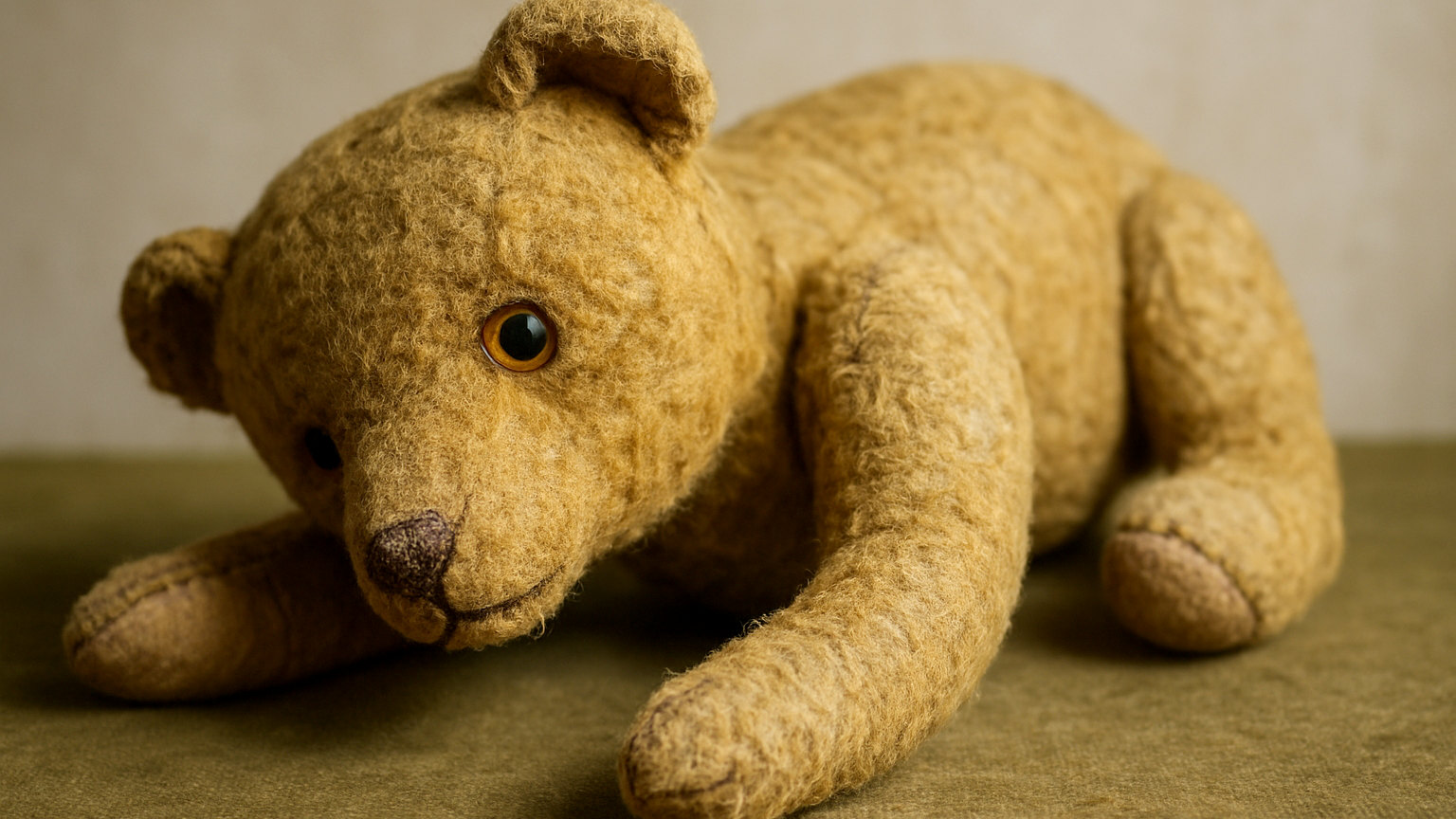
Long and lean rather than round. Early bears have noticeably long arms, frequently reaching well down the leg, with a pronounced curve at the paw. The snout is long and clearly defined rather than flat.
Look for a hump on the upper back, which is one of the most reliable early features, and for large feet with a narrow ankle. Later bears become shorter armed, flatter faced and rounder overall, losing the animal proportions entirely.
What are the eyes made of?
The earliest bears have boot button eyes: small solid black discs on a wire shank, quite literally the buttons used on boots. They are opaque with no depth to them.
Glass eyes came later, usually amber or brown with a black pupil, and have visible depth and shine. Plastic eyes are later still. Check whether the eyes match each other and whether the wire shanks are original, since replaced eyes are extremely common and reduce value.
What is the bear made of?
Mohair, which is fabric woven from angora goat hair, on early and good quality bears. It has a distinctive lustre and a slightly coarse feel quite unlike synthetic plush.
Stuffing helps date a bear too. Wood wool, which is fine wood shavings, gives a firm crunchy feel and is early. Kapok is softer and lighter. Later bears use synthetic filling, which feels quite different. Press gently and note how the body responds, and listen for the faint rustle of wood wool.
How are the joints made?
Early bears are jointed at the shoulders and hips with cardboard or wooden discs and metal pins, which allows the limbs to rotate. Feel for the disc through the fabric and rotate a limb gently.
Check that all five joints work, counting the head, since a seized or broken joint is a common fault. Some early bears have a growler or squeaker in the body, activated by tilting, and a working voice box adds value even though a great many have failed.
What about paw pads and the nose?
Pads on early bears are usually felt, and they wear heavily because they take handling. Replaced pads are so common as to be almost expected, and are acceptable when disclosed and sympathetically done.
The nose and mouth are embroidered in thread, and the stitching pattern varies between makers, which makes it a genuine identification feature. Count the stitches and note their direction. Reworked stitching is detectable by thread that is brighter and less worn than the surrounding fabric.
How much does condition matter?
Enormously, and originality matters more than tidiness. A bear with worn fur, thin patches and a well loved appearance is worth considerably more than one that has been restuffed, restitched and repaired invisibly.
Balding is expected and tolerated. What reduces value is replacement of original parts, particularly eyes, pads and stuffing, and any washing, which mats mohair permanently. Never wash an old bear. Surface dust can be lifted with a soft brush and nothing more.
What identifies the maker?
A button, tag or label, most famously a metal button in the ear on bears from one celebrated maker. Check both ears carefully, including for the small hole and fabric damage left where a button has been removed.
Absence of a label is normal, since most were removed or lost, so identify by construction instead: the shape, the stitching pattern of the nose, the joint discs and the proportions together. Where a bear may be by a significant maker, have it assessed by a specialist before selling, since the difference in value is very large.