Rocking horses are among the most appealing antique toys and among the largest, which keeps prices reasonable relative to the workmanship in them. They are also datable with unusual confidence, because the way the horse is mounted changed decisively and that change is visible from across a room.
What is a bow rocker?
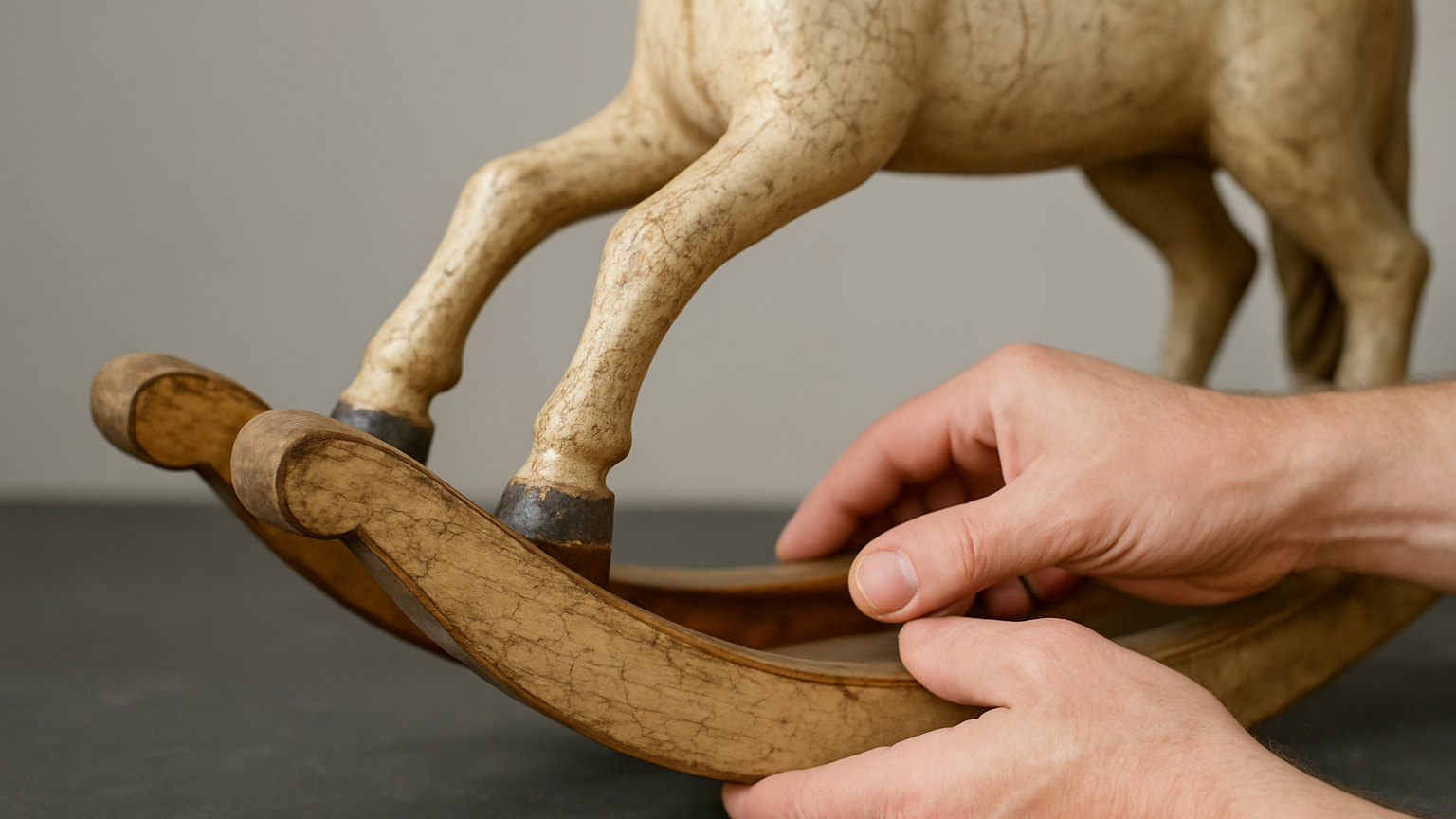
The earlier arrangement, where the horse is mounted on two curved wooden rockers running the full length, so the whole horse travels backwards and forwards as it rocks.
Bow rockers give a dramatic motion and take up considerable floor space, which is precisely why they were superseded. A horse on genuine original bow rockers is earlier and generally more desirable than one on a later stand.
What is a swing stand?
A rectangular frame with the horse suspended on pivoting irons, so it swings in place rather than travelling. It was safer, took less space and became the standard arrangement.
Look at the ironwork, which frequently carries a maker name or a patent reference stamped into it. The pivots wear and the irons corrode, so check them for repair and replacement, and confirm the horse hangs level.
How was the horse made?
Carved from solid timber blocks glued together, then covered in gesso, then painted and finished. The gesso layer smooths the carving and takes the paint.
Look at the carving quality where you can see it: the head, the nostrils and the treatment of the mane and tail are where the carver skill shows. Better horses have finely modelled heads with real expression rather than blunt generic ones.
What should you check on the surface?
Whether the paint is original. Dapple grey is the traditional finish, applied over a white ground, and original paintwork with honest wear is worth considerably more than a repaint.
Check for gesso cracks and losses, which are normal on a hundred year old horse, and for extensive filling. A horse that has been stripped and repainted has lost most of its original surface, and the difference in value is substantial.
What about the tack and fittings?
Original leather saddle, bridle, reins and stirrups add real value and are frequently missing or replaced, since leather perishes and children removed things.
Check the horsehair mane and tail, which are also frequently renewed. Look for the glass eyes, which should match and be securely set. Original tack in poor condition is generally better than modern replacements, so keep whatever survives.
Where do you find a maker mark?
On the stand ironwork, on a small brass or paper plate attached to the stand, or occasionally stamped into the timber of the frame.
Many horses are unmarked and identified by construction instead, since the major makers had recognisable carving styles, stand designs and paint treatments. Reference works illustrate these systematically and collectors identify unmarked horses routinely.
What condition issues matter most?
Structural soundness of the legs and the joints where they meet the body, since these carry the load. Check for splits and for repairs at each leg.
On swing stands, check the pivot irons and the frame joints. On bow rockers, check the rockers themselves for splits along the grain and for wear on the underside. A horse that has been ridden hard for generations may need work before it is safe.
Should one be restored?
Conservatively if at all. Structural repair to make a horse safe is entirely legitimate. Repainting is not, and it removes most of what a collector is paying for.
Specialist rocking horse restorers exist and understand the distinction. Ask specifically for conservation of the original surface rather than refinishing, and keep any original tack that is removed during work.
Are they worth buying?
Good ones by identified makers with original paint and tack attract serious money. Later and plainer examples are considerably more affordable and remain charming objects.
Measure before buying, since they are large and a bow rocker needs real floor space. Check the structure carefully if children will use it, and buy original surface over restored appearance every time.