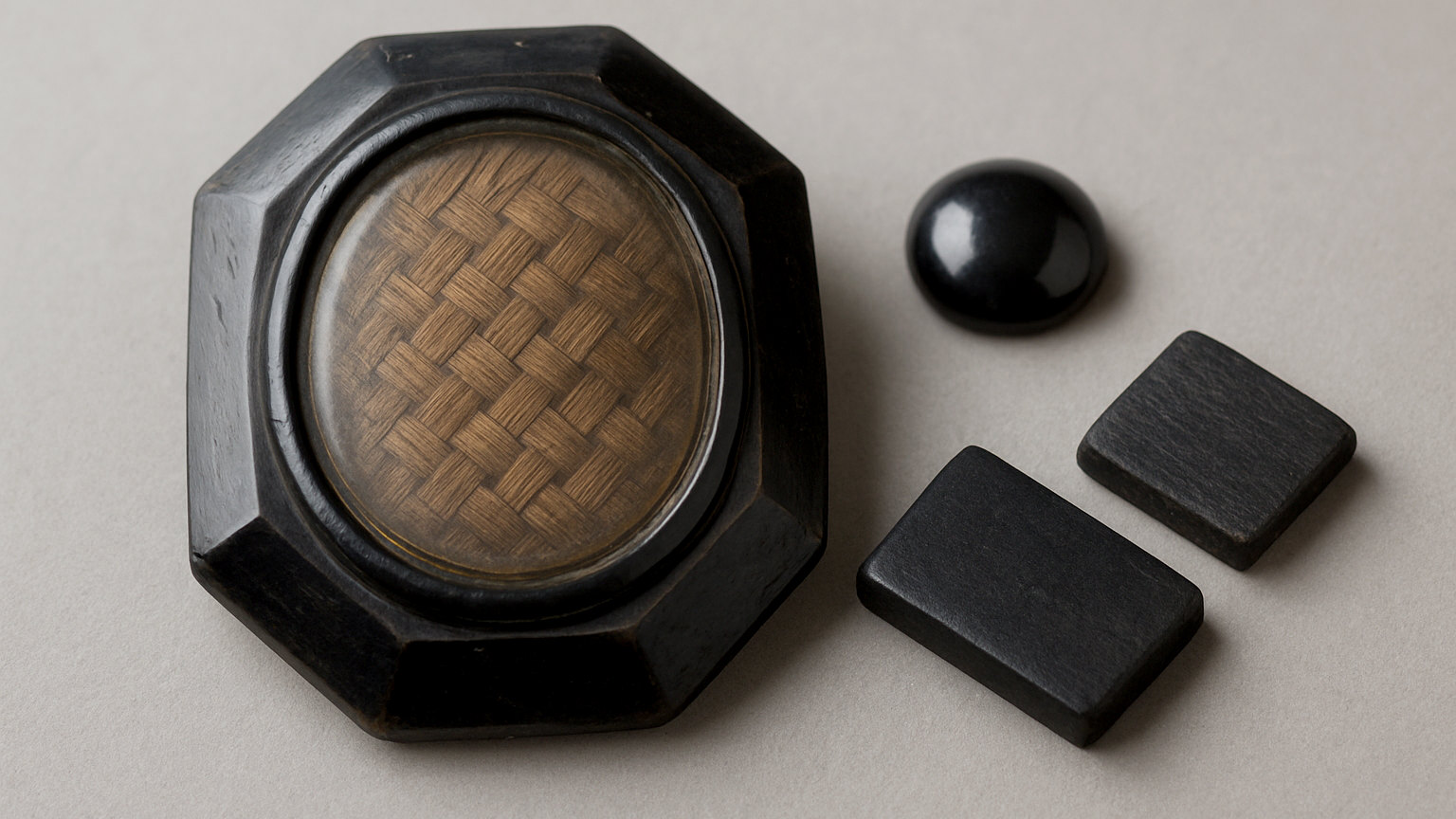
Black jewellery survives in large quantities because formal mourning was once a social requirement, and demand produced several different black materials competing at different price points. They look broadly similar in a photograph and differ substantially in value, so knowing how to tell them apart is worth a few minutes.
What is jet?
A form of fossilised wood, compressed over enormous periods until it becomes a hard black material that takes a high polish. It is organic in origin, which explains everything about how it behaves.
Being fossilised wood, it is remarkably light for its size, warm to the touch rather than cold, and it can be carved with fine detail. Good jet has a deep lustrous black shine and was worked into elaborate brooches, beads, crosses and lockets.
How do you tell jet from black glass?
Weight and temperature, both of which you can assess in the hand. Jet is noticeably light for its bulk and warms quickly against the skin. Glass is heavier and feels cold, and stays cold for longer.
Look at the surface under magnification. Glass, which was often called French jet, was moulded, so it may show a faint mould seam and the detail is softer. Jet was carved, so the tool work has slight irregularity. Glass also chips with a sharp glassy fracture, while jet chips to a matt black.
What is vulcanite?
Hardened rubber, produced by treating natural rubber with sulphur, and used extensively as an inexpensive jet substitute. It moulds beautifully, which is why vulcanite pieces often have crisp repeating detail.
The giveaway is colour change. Vulcanite discolours with age and light exposure, shifting from black towards a dull brown or khaki, particularly on surfaces that faced outward. A piece that is black in the recesses and brownish on the raised areas is almost certainly vulcanite. It is also warm and light, like jet, so colour is the better test.
What other black materials turn up?
Bog oak, which is timber preserved in peat, used for carved brooches and often decorated with recognisable motifs. It is light, has a visible wood grain if you look closely, and is dark brown rather than truly black.
Black enamel over gold or silver is quite different and generally more valuable, since the substrate is precious metal. Look for wear revealing metal beneath. Onyx, a stone, is cold, heavy and hard, and is easily distinguished from jet by weight alone.
Are there tests to avoid?
Several that are commonly recommended and should not be used. Rubbing jet on unglazed ceramic produces a brown streak, but it also abrades the piece. Touching a heated needle to it produces a smell of burning coal, and leaves a permanent mark.
Both are destructive and unnecessary, since weight, temperature and appearance answer the question on almost every piece. Never apply flame or heat to any jewellery you value, and never use solvents on unidentified black materials, since several of them dissolve or dull.
How should jet be cared for?
Gently, because it is softer than it looks and it is brittle. It scratches easily and will crack if dropped, so store pieces individually in soft pouches away from harder items.
Keep it away from heat and dry air, which can cause fine surface cracking, and away from prolonged direct sunlight. Clean with nothing more than a soft dry cloth, or a barely damp one if necessary. Avoid all chemical cleaners, ultrasonic machines and jewellery dips entirely.
What is this material worth?
Real carved jet from the recognised centres of production is the most valuable of the black materials, particularly larger pieces with fine carving, complete necklaces and anything with documented provenance. Condition matters greatly because chips are common and cannot be repaired invisibly.
Glass, vulcanite and bog oak pieces are worth considerably less individually, though good examples with strong design and intact fittings sell steadily. All of these are collected as mourning jewellery, so an inscribed or dated piece adds interest and value regardless of the material.