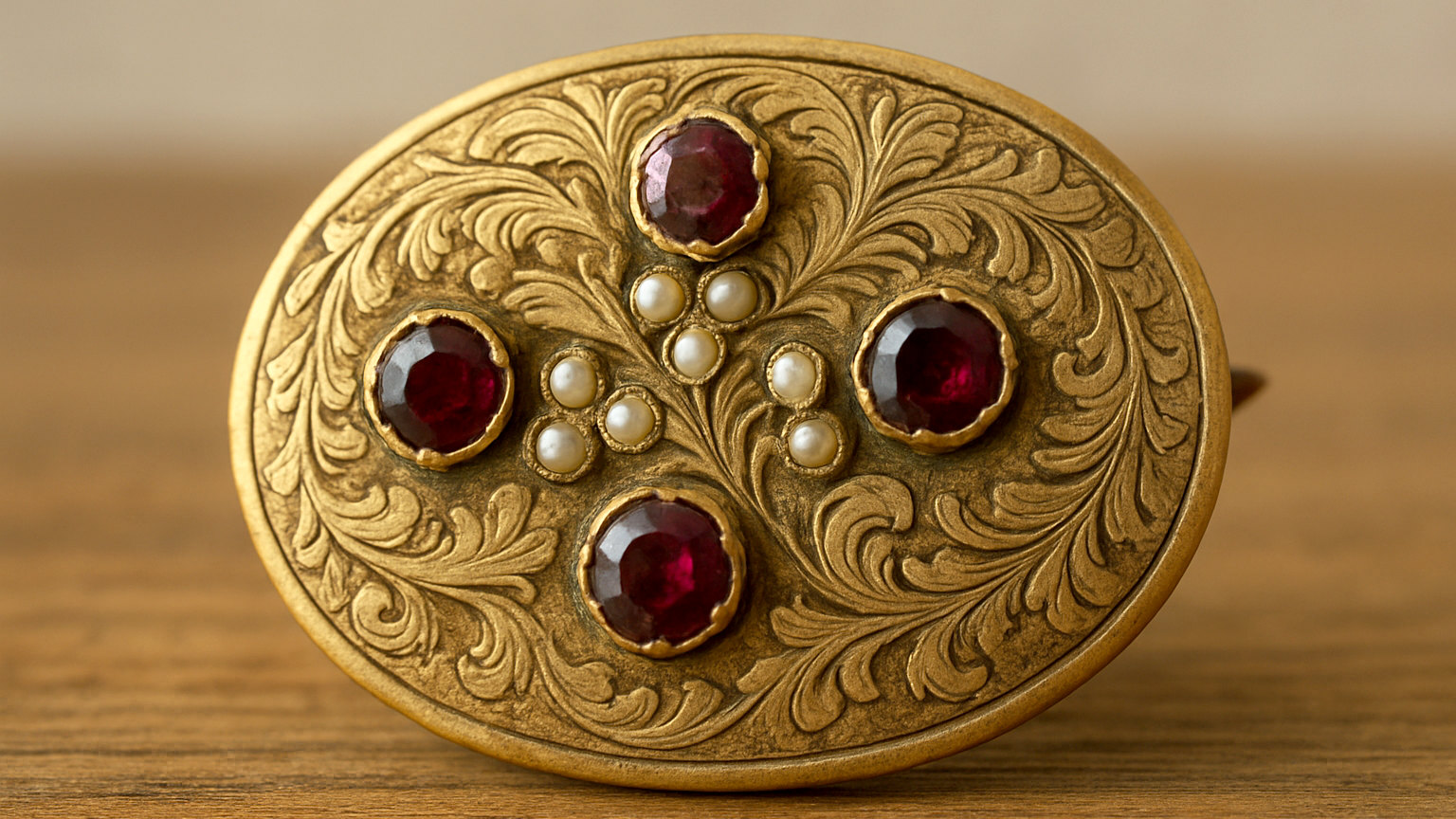
Paste is glass, cut and set to imitate gemstones, and it has an honourable history rather than a shameful one. It was worn openly by people who could afford real stones, made by skilled specialists, and set in precious metal. Fine period paste is collected in its own right today, so recognising it protects you from paying diamond prices and from discarding something genuinely good.
What is paste?
A high lead content glass developed specifically to imitate gemstones, cut with facets in the same manner as a real stone. The lead gives it weight and a high refractive index, which produces convincing sparkle.
It was made and set by specialists, frequently in silver or gold, and period paste jewellery shows the same design sophistication as gem set work of the same date. It was never intended as a cheap substitute in the way modern imitation stones are.
What is the quickest way to spot it?
Look at the facet edges under magnification. Glass is softer than most gemstones, so the sharp junctions where facets meet wear and become slightly rounded and dull with use.
A hard stone such as a diamond keeps knife sharp facet edges indefinitely. If the edges look softened, scuffed or slightly blurred, and the stone has small surface scratches, you are almost certainly looking at glass. Compare several stones in one piece, since they should have worn at similar rates.
Are there bubbles inside?
Frequently, and they are conclusive when present. Glass is melted and cooled, and tiny air bubbles get trapped during that process, appearing as small round or oval voids within the stone.
Look through the stone from the side under good magnification and strong light. Natural gemstones have inclusions too, but these look quite different: crystals, feathers, fine needles and colour zoning rather than perfect spheres. A round bubble is glass, every time.
What does a closed back setting mean?
That the stone sits in a metal cup closed underneath, so no light enters from behind. Very often a thin layer of coloured foil was placed beneath the stone to improve its brilliance and colour.
Closed backs and foil are common in period paste and in early gem set jewellery alike, so a closed back does not by itself prove the stones are glass. What it does mean is that the piece must never be immersed in water or cleaned ultrasonically, since moisture reaching the foil tarnishes it permanently and ruins the appearance.
Does temperature help?
A little, as supporting evidence. Glass conducts heat poorly and warms quickly against the skin, while many gemstones feel cold and stay cold for longer because they conduct heat away.
Touch the stone to your lip or the back of your hand and note how quickly it warms. This is unreliable on its own, since the metal setting affects the result and some stones behave unexpectedly, so use it alongside the facet edge and bubble checks rather than instead of them.
What should you not do to test it?
Scratch tests, which damage the piece whichever answer they give. Never drag a stone across glass or scratch it with anything, since a soft stone will be marked permanently and even a hard one can chip at an edge.
Breathing on a stone to see how quickly the mist clears is sometimes suggested and is close to useless in practice. If the answer matters financially, take the piece to a jeweller or a gemmologist, who can test properly without touching the surface.
Is paste jewellery worth anything?
Good period paste certainly is, and prices for the best examples have risen. Value rests on design quality, the workmanship of the setting, the metal, condition and period appeal rather than on the stones themselves.
Elaborate hand made settings, complete parures and pieces in original fitted cases all sell well. What paste will never do is fetch a price based on stone value, so never sell a piece to a buyer who assesses it purely on that basis without having the workmanship assessed first.