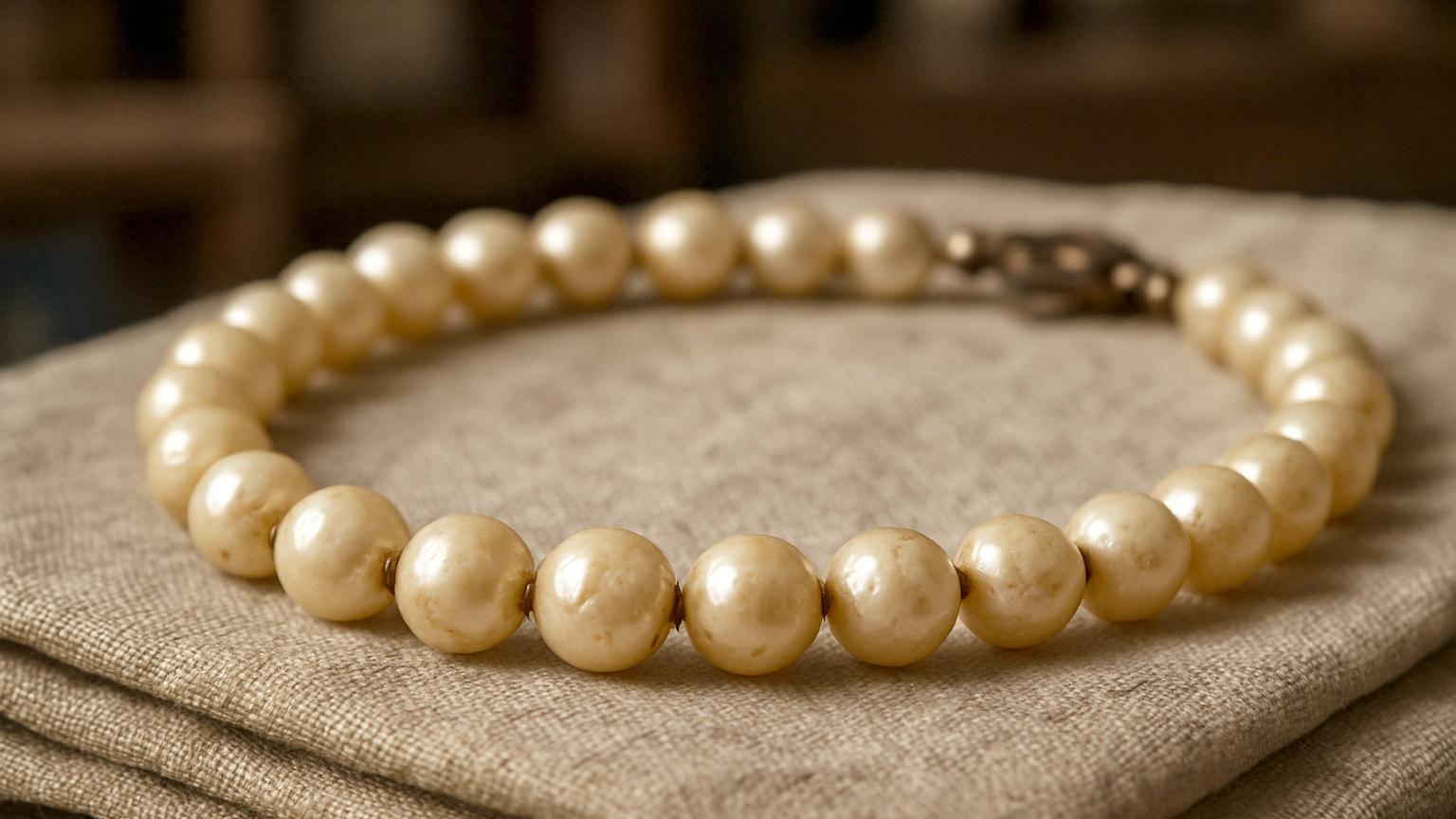
Pearls are the most commonly inherited jewellery and among the hardest to assess by eye. Three quite different things look similar in a photograph: natural pearls formed without human intervention, cultured pearls grown with a deliberately inserted nucleus, and imitations made of glass or plastic. The value gap between them is enormous.
What is the quickest test?
The tooth test, which separates imitations from real pearls in seconds. Rub a pearl gently against the biting edge of a front tooth and feel the texture.
A real pearl, natural or cultured, feels slightly gritty because the surface is built from microscopic layers of nacre. An imitation feels perfectly smooth, like glass or plastic. Use a clean tooth, rub very lightly, and test several pearls on a string rather than one.
What else identifies an imitation?
Look at the drill holes under magnification. On an imitation the coating frequently chips or flakes around the hole, revealing a glass or plastic bead beneath in a different colour.
Imitations are also lighter than real pearls of the same size, and they are uniformly perfect, since they were made rather than grown. Real pearls on a string vary slightly in size, shape and lustre however carefully matched, and that slight variation is reassuring.
How do natural and cultured pearls differ?
By what is inside. A natural pearl is nacre throughout. A cultured pearl has a bead nucleus inserted deliberately, with a layer of nacre grown over it, so the nacre may be quite thin.
This cannot be determined by eye, and it matters enormously since natural pearls are far more valuable. The only reliable method is radiography, which shows the internal structure. Any string that might be natural should be tested by a laboratory before it is sold.
Why does antique dating suggest natural?
Because culturing was developed comparatively recently. A pearl necklace demonstrably made before culturing became established is likely to be natural, which is why provenance and the age of the clasp matter so much here.
Look at the clasp for hallmarks and for construction consistent with an early date. An old clasp on a string of pearls is genuine evidence worth pursuing, though pearls are restrung regularly so a clasp can be reused or replaced.
How do you judge quality?
By lustre above everything. Good pearls have a deep glow with light appearing to come from within, and you should be able to see a sharp reflection on the surface.
Then surface cleanliness, meaning freedom from blemishes and pitting, then shape, then how well matched a string is for size and colour. Size matters but lustre matters more, and a smaller string with exceptional lustre outperforms a larger dull one.
What does the string tell you?
Whether the necklace has been cared for. Pearls should be strung on silk with a knot between each one, so that a broken string loses one pearl rather than all of them and the pearls do not rub together.
Check the knots are present and tight, and look at the silk near the clasp where wear concentrates. Discoloured, stretched or fraying silk means restringing is due. Pearls worn regularly should be restrung every year or two.
Why are pearls so vulnerable?
Because nacre is soft and easily damaged by anything acidic. Perfume, hairspray, cosmetics and even perspiration dull the surface permanently, and the damage is cumulative.
The rule is that pearls go on last and come off first. Wipe them with a soft damp cloth after wearing and let them dry before putting them away. Never use jewellery dips, never use an ultrasonic cleaner, and never immerse a strung necklace since water rots the silk.
How should they be stored?
Flat, in a soft pouch, separately from other jewellery. Hanging a necklace stretches the silk over time, and harder stones stored alongside will scratch the nacre.
Keep them somewhere with a little humidity rather than in a bank vault or a very dry safe, since nacre contains water and can crack if it dries out completely. Pearls benefit from being worn occasionally, which is one of the few pieces of traditional jewellery advice that is genuinely sound.