Earrings are dated from the back rather than the front, because the decorative element followed fashion while the fitting followed practicality. Fittings improved steadily and each type entered use at a recognisable point, which makes them the most reliable evidence on the piece. They are also the part most frequently replaced.
What is a shepherd hook?
A simple curved wire passing through the ear and hanging free, sometimes with a small loop or bead at the end. It is the oldest and simplest fitting and remained in use for a very long time.
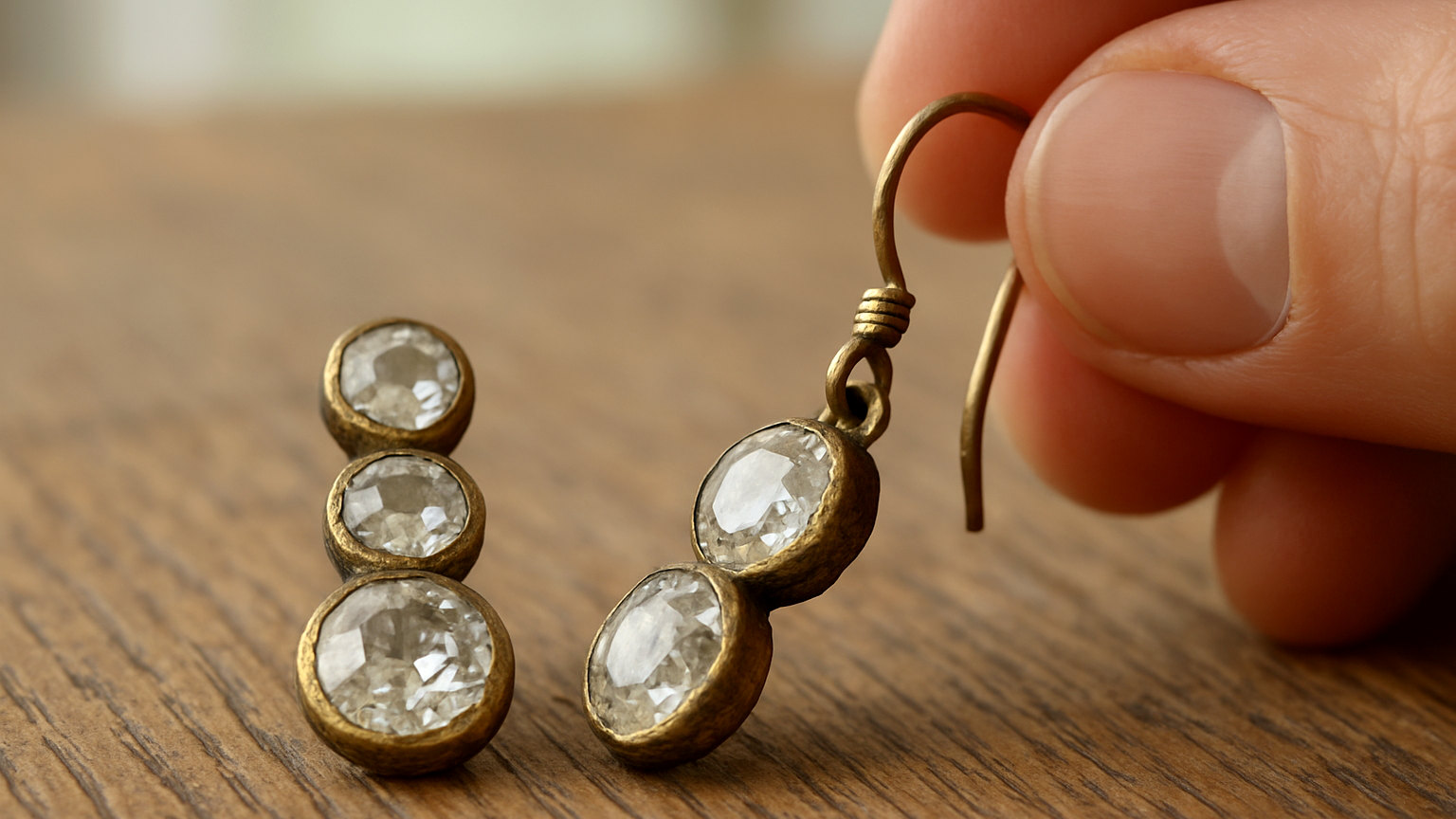
Early hooks are hand made, so the wire tapers slightly and the curve is not perfectly regular. Look at the join where the hook meets the decorative element, which on early work is a soldered loop rather than a manufactured jump ring. A hook that is perfectly uniform in gauge is usually later or a replacement.
What do screw fittings indicate?
Unpierced ears and a later date. Screw backs consist of a small threaded post with a disc that tightens against the back of the earlobe, and they arrived once wearing earrings without piercing became fashionable.
They are a firm dating line, since a screw back cannot predate the mechanism. Check whether the screw is original or added, by looking at whether the fitting was designed into the piece or soldered on afterwards, and whether the metal colour matches.
What about clips and posts?
Clip fittings, using a hinged lever pressing against the back of the lobe, are later than screws. Modern posts with butterfly backs are later again and on an antique piece almost always indicate conversion.
Conversion is extremely common because fashions in piercing changed repeatedly, and each change prompted people to have their earrings altered. It is not dishonest, and a converted pair is perfectly wearable, but it does reduce value and should be disclosed.
How do you spot a conversion?
By looking for evidence of the previous fitting. Solder marks, a small patch of differently coloured metal, filled holes, or a fitting that sits awkwardly against the design all indicate later alteration.
Examine under magnification where the fitting meets the body of the earring. Original fittings are integral to the design and balanced for the weight of the drop. A fitting positioned so the earring hangs badly is almost certainly a replacement.
What are the main earring forms?
Studs and clusters sitting close to the lobe, drops hanging on a short link, and longer pendant or girandole forms with multiple hanging elements.
Girandoles, with three drops suspended from a central element, are a distinctive early form. Long articulated drops move as the wearer moves, which was the point. Look at how many separate elements are present and whether all the links and drops survive, since missing drops are common and difficult to match.
What should you check on the stones and settings?
The same features as any period jewellery. Closed back settings with foil beneath the stones indicate earlier work and mean the pair must never go near water.
Look at the cuts: old mine and rose cuts have distinctive proportions quite unlike modern brilliants. Check that both earrings match in stone size, colour and cut, since a replaced stone in one of a pair is very common and reduces value considerably. Compare them side by side under one light source.
Are they safe to wear?
Check the fittings before assuming so. Old hooks work harden and snap, screw threads wear until they no longer grip, and the loops connecting drops wear thin at the pivot.
Run each earring through your fingers looking at every link and join. Pay particular attention to the loop the whole weight hangs from, since that is where failures happen. A jeweller can replace a worn hook sympathetically, and doing so before wearing is far better than losing an irreplaceable drop.
Are single earrings worth anything?
Considerably less than half a pair, which surprises people. A pair is a wearable object and a single is not, so the market treats it as parts rather than as jewellery.
That said, a single earring from a fine period pair is worth keeping rather than scrapping, since it can sometimes be matched or converted into a pendant. Have it looked at by a jewellery specialist before accepting any offer based on metal weight alone.