Bangles and bracelets survive in large numbers and are frequently unmarked, since many fell below the weight thresholds that required hallmarking. That leaves the fittings to date them, and fortunately clasps and hinges improved steadily in ways that are easy to see once you know what changed.
What is the difference between a bangle and a bracelet?
A bangle is rigid, either a closed circle slipped over the hand or a hinged form that opens. A bracelet is flexible, made of linked elements or a woven band.
The distinction matters because they are constructed quite differently and dated by different features. On a bangle you assess the hinge and catch; on a bracelet you assess the links and the clasp. Both may carry a safety chain, which is itself informative.
What does the clasp tell you?
More than the decoration does. Early clasps are frequently a simple tongue engaging a box, sometimes with a separate push piece, and are hand made with slight irregularity.
Barrel clasps that screw together indicate earlier work. Bolt rings came later. Later still are the larger spring clasps and modern lobster forms, which on an antique piece indicate a replacement. Look at whether the clasp is integral to the design or an applied component, since integral clasps generally indicate better quality.
How do you assess a hinged bangle?
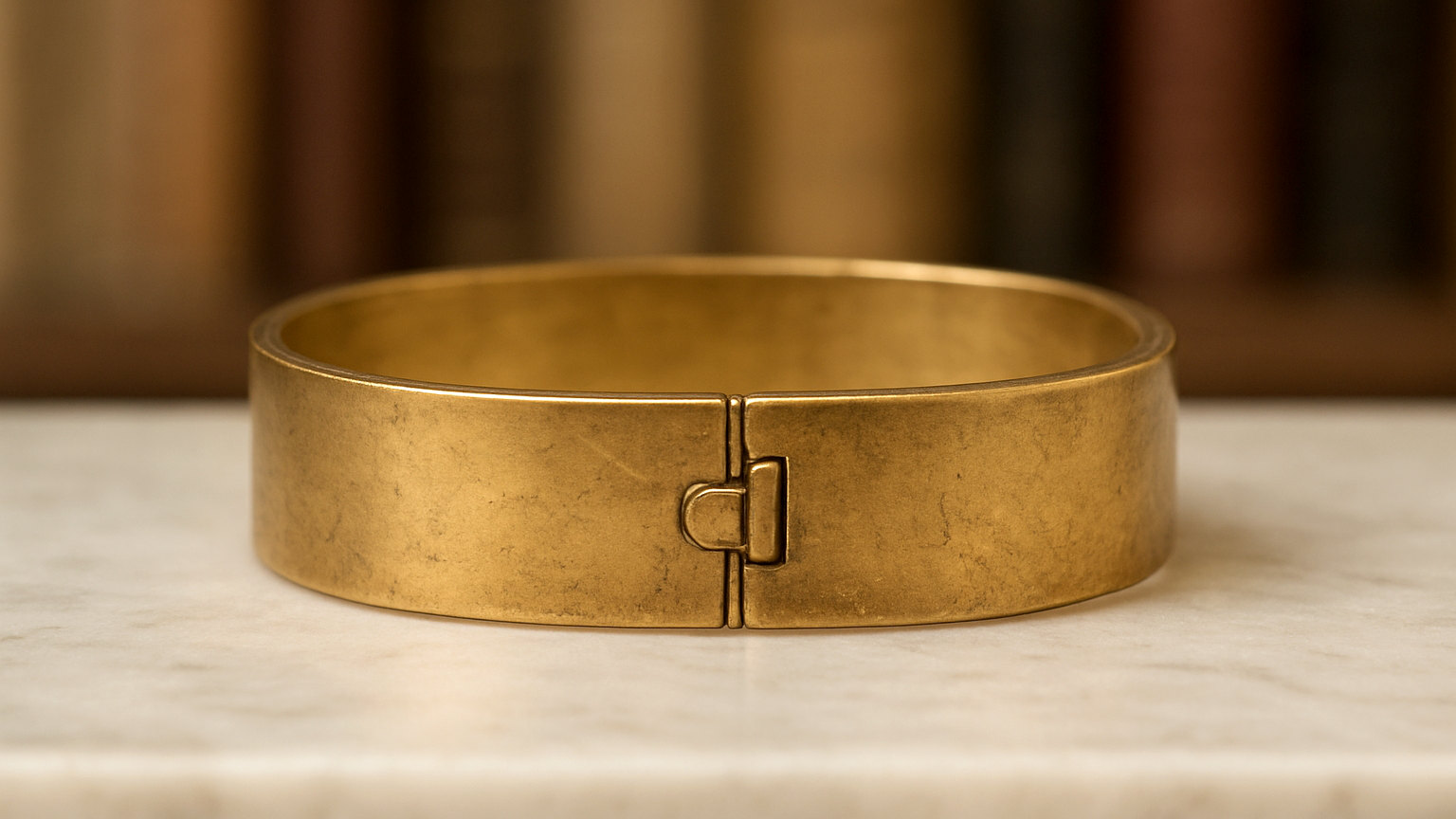
By the hinge construction and the fit. Early hinges are made from interlocking knuckles with a pin through, worked by hand, and the two halves should close so precisely that the join is barely visible.
Check the catch engages firmly and that a safety fitting is present. A hinged bangle almost always had a safety catch or chain, and its absence usually means it has been lost. Look for solder marks where one may have been removed.
Is the bangle hollow?
Very often, and it matters for both value and repair. A great deal of antique gold jewellery is made from thin sheet formed over a core, then filled or left hollow, which gave substantial appearance at modest metal cost.
Hollow pieces dent easily and are difficult to repair, since heat and pressure both risk collapsing the form. Press very gently at a plain section and feel whether the metal gives. A hollow bangle that has been dented and pushed out will show slight rippling.
What is a gate bracelet?
A flexible bracelet made from linked expanding sections resembling a gate, usually with a padlock clasp and a safety chain. These were made in enormous numbers and remain among the most commonly encountered antique bracelets.
Check that the padlock is original and that its key, if there was one, is present. Look at the links for repairs, worn joints and replaced sections, since these bracelets flex constantly and wear at the pivots. A complete example with original padlock and safety chain is worth noticeably more.
How do you check the metal?
Look for a mark first, on the clasp, the padlock or inside the band, though absence proves nothing given the exemptions. Then have it tested electronically by a jeweller, which is quick and does no damage.
Look at wear points, since rolled gold and gilt pieces show base metal breaking through at the high spots and along the edges. A magnet is a useful first check because gold is not magnetic, though many base alloys are not either. Avoid acid testing kits on anything you may keep.
What should you check before wearing one?
The clasp, the safety fitting and every link. Open and close the clasp several times and feel whether it engages firmly, since a worn spring is how bracelets are lost.
Run the piece slowly through your fingers looking for links that have opened, worn thin or been repaired with a different pattern. Pay particular attention to the links immediately either side of the clasp, which take the most stress. Have anything loose repaired before wearing rather than afterwards.