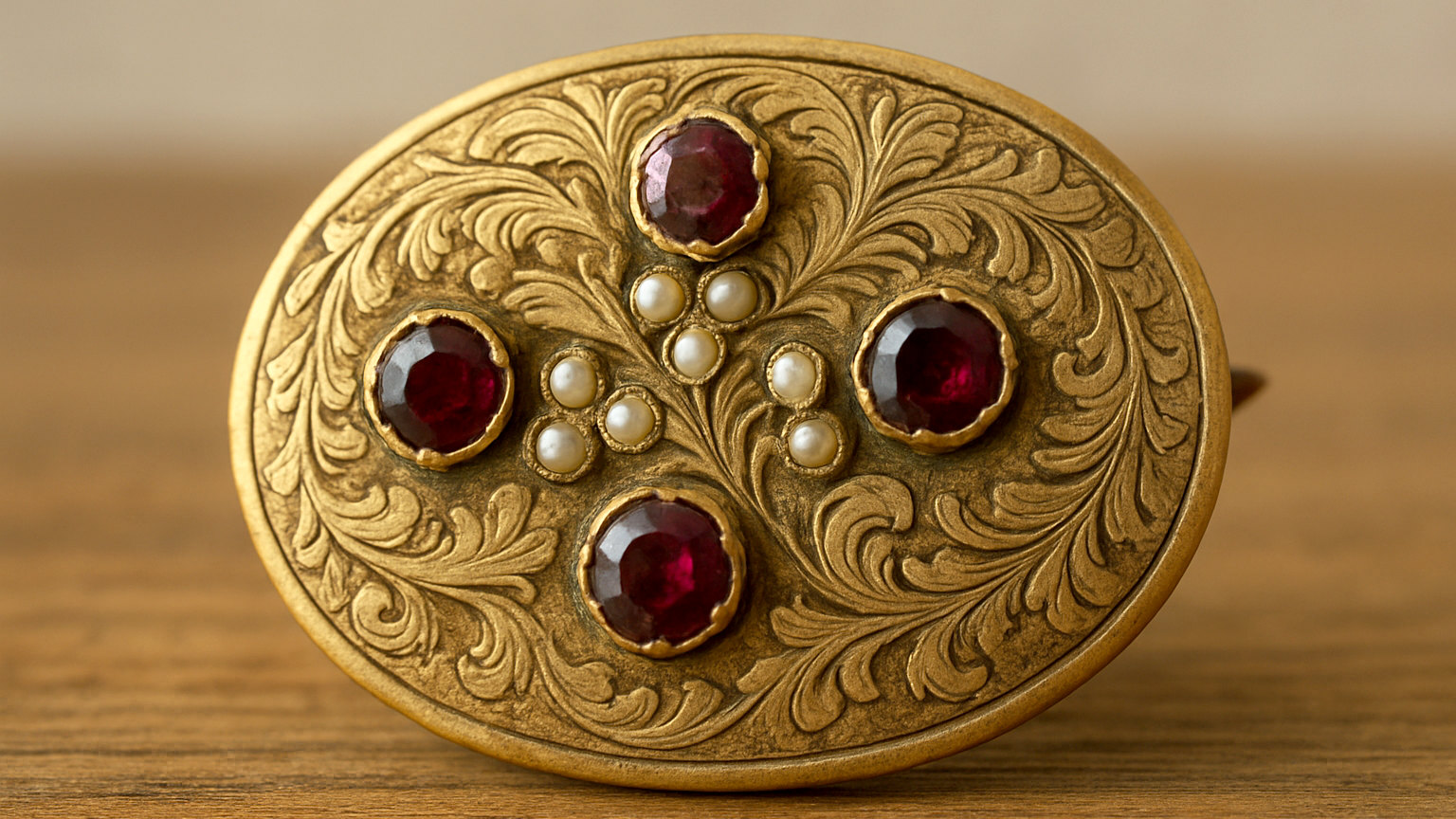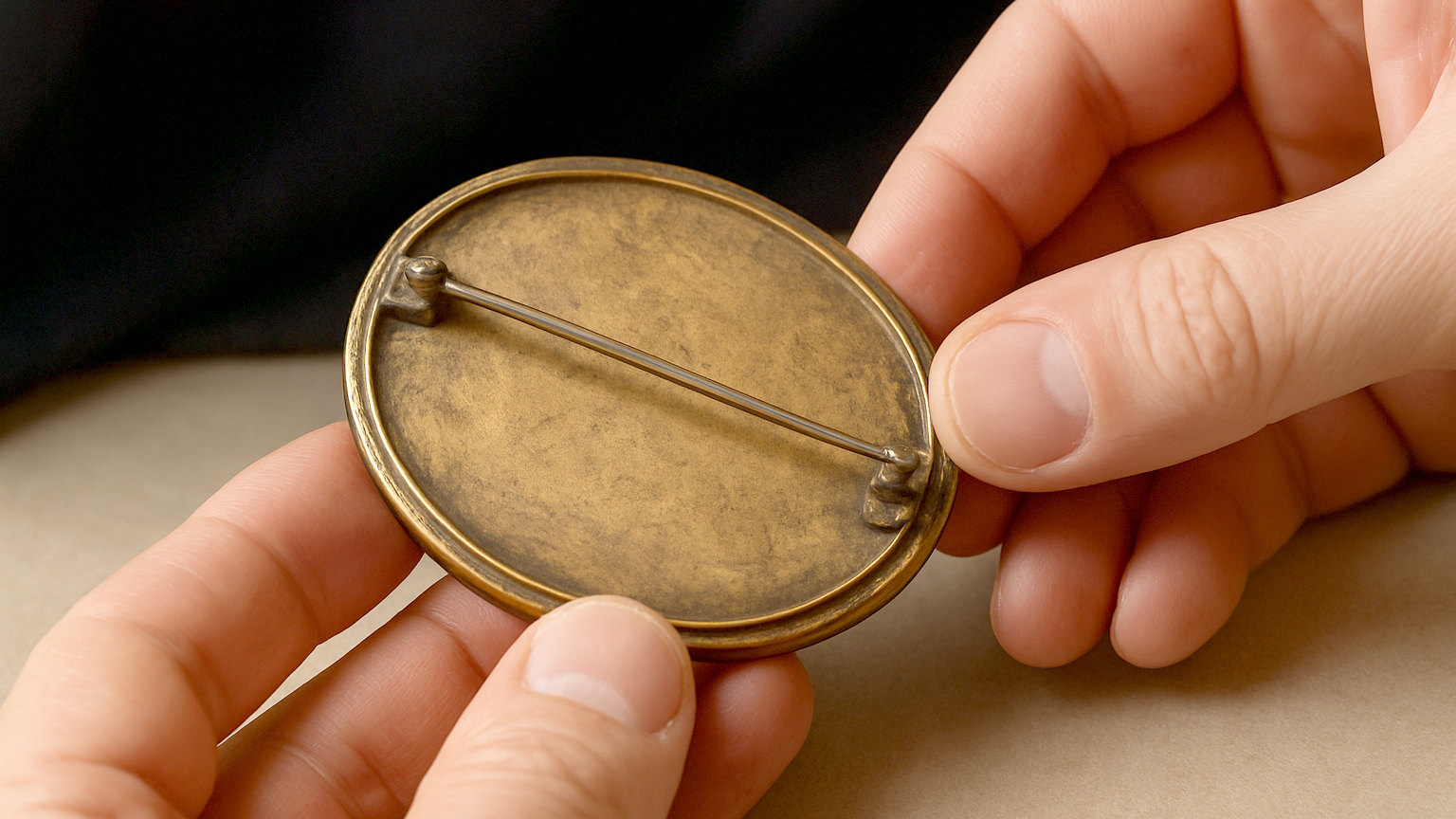
Brooch designs were revived and copied endlessly, so the front of a brooch tells you what the maker was aiming at rather than when they worked. The back is quite different. Fastenings were functional engineering that improved over time, and the type of hinge, pin and catch fitted places a brooch far more reliably than any decorative feature.
Why is the fastening so reliable?
Because it was never decorative. Nobody revived an obsolete catch for aesthetic reasons, and each improvement was adopted because it worked better and stopped brooches being lost.
Manufacturers moved to better fastenings as they became available, so the mechanism gives you an earliest possible date. A brooch cannot predate its own catch, which makes this the most useful single check on the piece.
What does the pin itself tell you?
Length first. On earlier brooches the pin frequently extends well beyond the edge of the body, sometimes by a considerable margin, because it had to pass through and grip thick heavy fabrics.
Later pins are shorter and sit within or barely beyond the outline, reflecting lighter clothing. A long protruding pin is a good early indicator. Check also whether the pin is a simple wire tapering to a point, which is earlier, or a more finished component.
How did the catch develop?
The earliest arrangement is a simple C shaped hook with an open end, into which the pin drops and is held by nothing more than tension. These are entirely open and lose pins easily.
Later came catches with a longer hook curving further round, then the roll over safety catch with a small revolving cover that closes across the opening. That safety catch is a firm dating line, since brooches fitted with one from new cannot be early. Be aware that safety catches were frequently added to older brooches as a repair, which is why the whole back must be read together.
What about the hinge?
Early hinges are usually a simple arrangement of a wire pin bent and set between two small plates, or a rolled tube through which a pin passes. The workmanship is hand made and slightly irregular.
A tube hinge, where the pin pivots inside a short cylinder, is a good early sign. Later hinges are machine made, perfectly regular and often a small stamped assembly. Look at whether the hinge components are integral to the brooch back or applied as a separate manufactured unit, since the latter indicates later production.
How do you spot a converted brooch?
Look for fittings that do not belong. A brooch converted from something else, or fitted later with a pendant loop, will show solder marks, a difference in metal colour, or fixings that sit awkwardly against the design.
Conversion works both ways: brooches were made into pendants and pendants into brooches, and dress clips were frequently converted. Check whether the fastening is centred and positioned sensibly for the weight of the piece, since an off centre or poorly placed fitting suggests it was added rather than designed in.
Does a replaced catch reduce value?
Modestly, and far less than losing the brooch would. A repair carried out because the original failed is part of the object history, and a sympathetic replacement that allows a piece to be worn safely is usually the right decision.
What matters is that it is disclosed and understood. A brooch with an early hinge, a long pin and a later safety catch is almost certainly early with a repair, and reading all three features together gives you a much better answer than any one alone.
What should you check before wearing one?
The catch closes fully and holds under gentle pressure, the pin is straight and springs back against the catch, and the hinge has no play in it. A worn hinge lets the pin wobble and is how brooches are lost.
Have anything loose repaired by a jeweller before wearing rather than after. Never force a stiff safety catch, and store brooches with the pin fastened so it cannot bend or catch on other pieces.